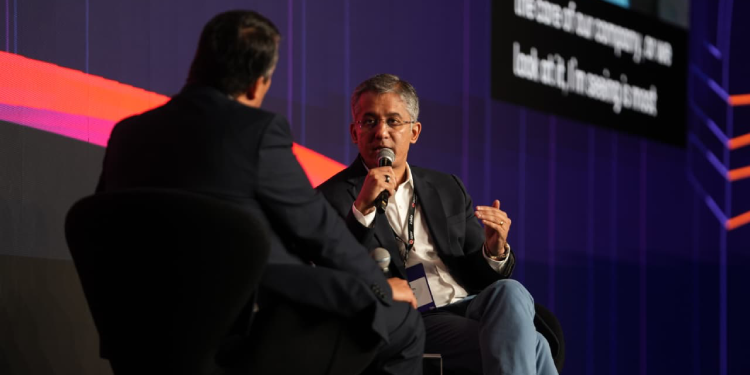
Mumbai: At APOS 2026, Kevin Vaz, CEO – Entertainment, JioStar, shared insights into the company’s transformation journey following the merger that brought together two of India’s largest media and streaming ecosystems, outlining how scale, technology and consumer-centric innovation are shaping the future of entertainment.
Speaking during a fireside session titled ‘Redefining Scale’, Vaz reflected on the integration process and described the last 18 months as one of the most defining periods for both the company and the broader media industry.
Addressing the evolution of JioStar, Vaz said the merger completed on November 14, 2024, bringing together two of India’s leading streaming platforms. Within three months, JioCinema and Disney+ Hotstar were integrated into a unified platform under JioHotstar.
Highlighting the scale achieved since integration, Vaz said JioHotstar today serves more than 500 million monthly active users, has crossed one billion app downloads, achieved 100% pin code coverage across India and manages over 260 million paid subscriptions.
However, he emphasised that scale is no longer defined purely by reach.
“One way of defining scale is all the metrics that I talked about, and numbers. But I think if you ask me, the definition of scale has changed. Scale is not about how many people you reach. I think scale is defined as what is the impact you have on people’s lives after you reach them,” Vaz said during the session.
Discussing the company’s operating philosophy, Vaz positioned JioStar as a technology-led entertainment company.
“Clearly, for us, we see JioStar as a technology company that also delivers content. Storytelling will always be at the core of everything that we do,” he said.
According to Vaz, technology now plays a central role in how stories are distributed, personalised and experienced at scale. He highlighted innovation across AI, content discovery, short-form experiences and the company’s collaboration initiatives as key differentiators.
He also pointed to the growing convergence between entertainment and commerce, describing it as one of the biggest inflection points for the industry.
Vaz noted that digital environments now allow consumers to move seamlessly between watching, interacting and transacting. He cited examples including integrations that enabled users to order food while watching sports and commerce-led partnerships tied to entertainment programming.
On monetisation opportunities, Vaz said commerce is emerging as an important future revenue stream beyond advertising and subscriptions.
“Industry today has always had just two revenue streams, advertising and subscriptions… But it’s important to come up with new revenue streams. And clearly, commerce is something that we think would be a really big revenue stream as we go forward,” he said.
The discussion also touched upon JioStar’s expansion into micro-drama content through Tadka, its short-form storytelling offering launched in April.
According to Vaz, the format has already attracted nearly 100 million consumers in six to eight weeks, reflecting changing content consumption behaviour and demand for seamless experiences across formats and devices.
Speaking about screen behaviour in India, Vaz reiterated his long-held view that India remains an “AND market,” where consumers move fluidly across television, connected TV, mobile and short-form formats rather than treating them as competing experiences.
Today, he noted, JioHotstar reaches more than 85 million connected TV homes while benefiting from India’s expanding internet and smartphone ecosystem.
Looking ahead, Vaz said entertainment will become increasingly participatory rather than passive.
“If I have to look at it going forward, entertainment will change from being a passive consumption to being a much more active, involved consumer,” he concluded.
The session underscored JioStar’s broader strategy of building an integrated media ecosystem where content, technology, commerce and personalisation work together to redefine entertainment experiences at scale.