Earlier this year Onetab.ai, an AI Agentic platform, launched of its Enterprise AI Agentic Solutions — a suite of intelligent automation capabilities built on a proprietary AI Agent Builder engine. The platform the company explains integrates seamlessly with 150+ enterprise tools and leverages the combined power of Anthropic Claude, OpenAI, and Google Gemini models to design, deploy, and manage bespoke AI Agentic and automation workflows at enterprise scale.
Onetab.ai also has mie, Your Everyday AI Assistant, an all-in-one AI assistant that helps you chat, search, write, translate, and generate creative images.
As the first company in India to develop and own a full-stack AI Agentic Builder with cross-industry applications, Onetab.ai redefines what is possible in enterprise productivity — positioning itself well ahead of global workflow automation players such as n8n and Zapier with deep AI-native capabilities tailored for Indian and global enterprise needs.
From the Heart of India to the Global AI Stage: What makes Onetab.ai’s story particularly remarkable is where it began — not in a Silicon Valley garage or a Bengaluru tech park, but in Indore, Madhya Pradesh. One of India’s fastest-growing cities, Indore has long been celebrated for its entrepreneurial culture, clean governance, and rising startup ecosystem — and with Onetab.ai, it now earns a new distinction: a launchpad for world-class artificial intelligence innovation.
Onetab.ai’s rise from Indore to serving 150+ enterprise clients across India and beyond is a testament to the untapped potential that exists beyond India’s traditional tech metros. The company said that it is proud to put Indore on the global AI map — demonstrating that breakthrough technology can emerge from any corner of the country when vision, talent, and ambition converge.
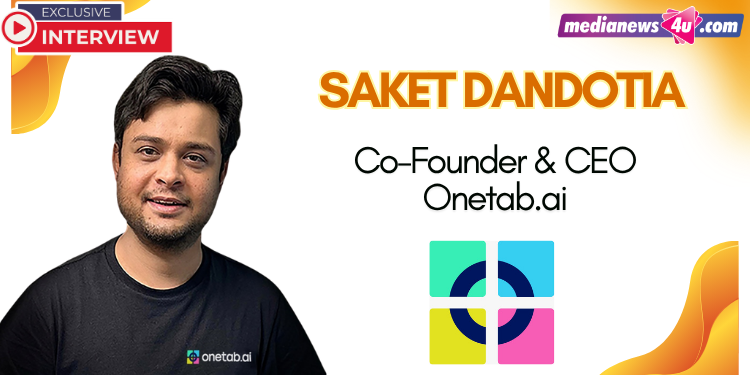
Medianews4u.com caught up with Saket Dandotia, Co-Founder, CEO, Onetab.ai
Q. Why did you start an AI tool for software developers when most people in India are focused on building AI apps for customer service or marketing?
I started Onetab.ai because that’s where I felt the pain personally. I spent years running engineering teams, and the idea for Onetab literally came on a trip to Goa when I couldn’t pull up Trello to check a ticket. Marketing and support AI is a crowded, fast-commoditizing space.
Software development is a harder, stickier problem – the workflow is fragmented across a dozen tools, the buyers are global from day one, and almost nobody was building a unified, AI-native layer across the whole SDLC. We went where the moat is deeper, not where the noise is loudest.
 Q. What does Onetab do to help developers that regular project tools like Trello or Jira cannot handle?
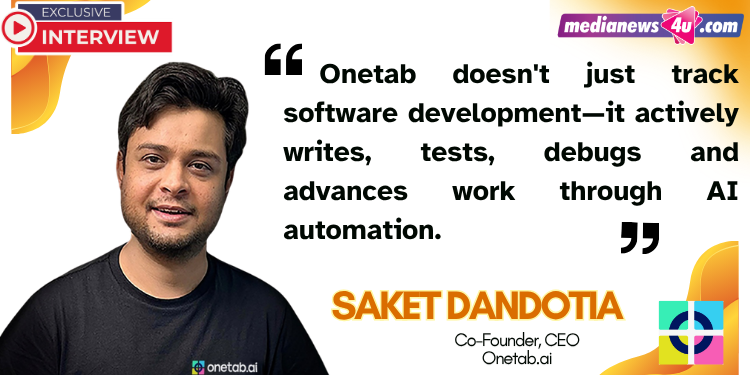
Onetab does the work, while other are focussed on tracking the work. OneAsk, our AI agent to manage the complete Software Development Life Cycle (SDLC), just doesn’t show you a ticket – it can write and debug the code, generate and run tests, surface deployment insights, and update the board itself, all from natural language.
The other difference is unification: instead of stitching together planning, coding, QA, and deployment across separate tools, we collapse the whole lifecycle into one source of truth. While others tell you a task is “in progress.” We move it forward.
Q. When a development team uses your AI agent, does it replace human coders, or just change what they do all day?
It changes their day. The toil disappears — boilerplate, test scaffolding, status updates, hunting through tickets — and what’s left is the work engineers actually want: architecture, judgment, hard tradeoffs, design.
I am not going to pretend the job stays identical; the mix shifts, especially for routine tasks. But a good engineer with an agent ships more of what matters, and that’s a multiplier on talent, not a replacement for it.
Q. How do you measure if your AI is actually making a tech team faster, rather than just forcing them to fix AI-generated mistakes?
This is the right question, and the honest metric is net productivity, not gross speed. We look at DORA-style numbers: cycle time, lead time to deploy, change-failure rate, and rework — code that gets reverted or reopened after merge.
If suggestions are accepted but the change-failure rate climbs, we haven’t helped; we have just moved the work downstream. So we track acceptance rate against escaped-defect and rework rates together.
Q. A recent Boston Consulting Group report says that over half of Indian marketing heads expect AI to bring in an extra 5% to 9% in revenue. Since your company focuses on software developers and not marketers, do you think tech teams can promise those same kinds of revenue growth numbers, or is software development just about cutting costs?
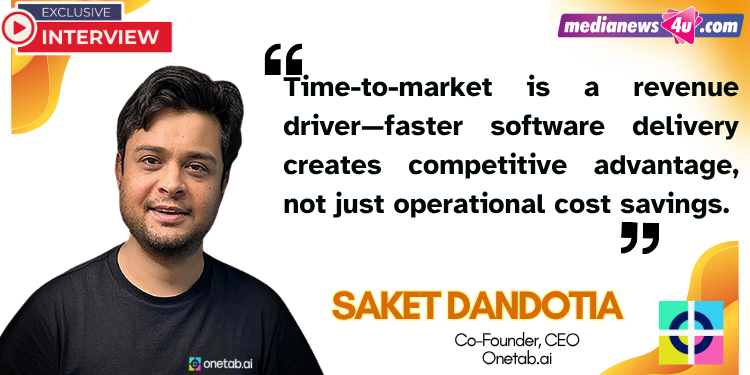
Cost is the easy story to tell, but it’s not the whole one. Time-to-market is a revenue lever: ship the feature a competitor hasn’t, capture the customer first, respond to the market in days instead of quarters. Reliability protects revenue too — outages and bad releases cost real money.
So I would push back on the framing. Marketing’s number is about demand generation; ours is about how fast and how well you can build the thing that generates demand. The percentages look different, but the P&L impact is just as real.
 Q. How did you manage to secure $3.3 million in seed funding at a time when global investors are being cautious and demanding clear, immediate profitability from AI startups?
By not being a feature pretending to be a company. Three things gave investors conviction: scope — we own the whole SDLC, not one autocomplete corner; defensibility — proprietary models and private hosting, which matters enormously to enterprises that can’t send code to a public API; and traction — real paying enterprise customers, not just signups.
Add a founding team that’s built and exited before, and you have a story about durable value, not a hype cycle. Capital is cautious right now, which actually rewards companies with a clear path rather than a slide deck.
Q. What happens to a tech team’s workflow and data security when your AI platform stops working or experiences unexpected downtime?
Two things. On security: with private and on-prem hosting, customer code and data live in their environment, so an outage on our side doesn’t expose anything — there’s no central pool of client code to leak.
On availability: we build for redundancy and graceful degradation, and because we don’t lock data in, a team is never stranded — their repos, tickets, and history remain theirs and portable. Downtime is a productivity hit, not a data event, and that’s a deliberate architectural choice.
Q. When major tech platforms face massive antitrust rulings—like the recent legal issues Google faced—how does that shift the playground for smaller Indian AI companies trying to build their own independent demand?
It opens doors. A lot of incumbent advantage comes from bundling and default placement – the tool you use because it’s already in your stack, not because it’s best.
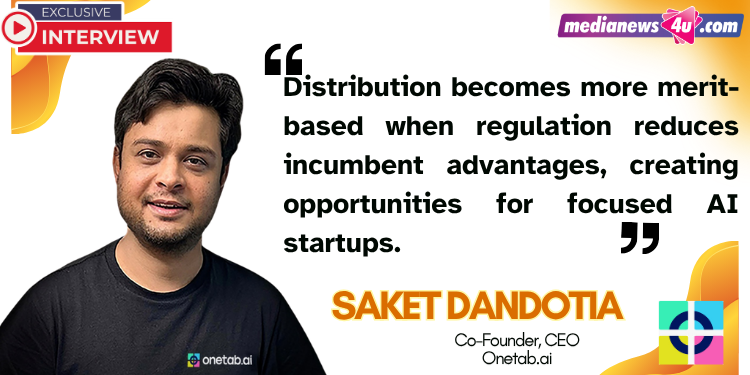
When regulators loosen that grip, distribution gets a little more merit-based, and independent players get a fairer shot at being chosen on quality. It won’t hand us the market, but it lowers the wall. For a focused company that’s genuinely better at one hard thing, a less rigged playing field is good news.
 Q. The BCG report highlights a major shift toward “Agentic Marketing,” where AI works on its own without needing a human to guide every single step. If software development moves toward this autonomous agent model, who takes the legal and financial blame when an independent AI agent pushes buggy code that breaks a bank or an e-commerce store?
The deploying organisation, the same as today – and anyone who tells you otherwise is selling something dangerous. That’s exactly why, in high-stakes and regulated contexts, we keep a human in the loop with approval gates, full audit trails, and testing the agent can’t bypass.
The agent’s job is to make the human dramatically more productive and to leave a clean record of what it did and why, not to push to production unsupervised. Accountability doesn’t get to be autonomous just because the code is. As autonomy increases, the guardrails and traceability have to increase with it, not loosen.
Q. Why should an Indian corporate tech team trust a young startup like Onetab.ai instead of using AI developer tools built by majors like Microsoft or GitHub?
Three reasons. Focus: Copilot is brilliant autocomplete, but it’s one slice; we own the whole lifecycle as a unified system. Data sovereignty: private hosting means sensitive code never leaves the enterprise’s environment, which matters a great deal for Indian and regulated customers wary of sending IP to a US hyperscaler.
And partnership: with us, you get customization, responsiveness, and a roadmap you can actually influence — try getting that from a trillion-dollar platform. We’re the challenger, and challengers earn trust by being closer to the customer and more aligned with their data.
Q. The BCG report shows that Indian companies are moving AI from an “illusion to reality.” What is the biggest lie that Indian tech founders are currently telling investors about what their AI can actually do?
“It’s fully autonomous and proprietary.” Two overclaims, really. The first is the demo-to-production gap – a slick demo gets sold as production-grade reliability, and the rework rate tells a very different story. The second is the “proprietary model” claim from companies that are thin wrappers on someone else’s API with a prompt and a logo.
The honest version is harder to pitch: most useful AI today still needs a human in the loop, and the moat is in workflow, data, and integration, not in pretending you trained a frontier model in a garage. The market is maturing, and investors are getting better at spotting the gap.
 Q. Looking at the BCG data on fast enterprise adoption, what is your plan to keep Onetab.ai relevant over the next two years when foundational AI models change every few months and could easily absorb your features?
By not betting the company on a single feature, a model can swallow. Foundation models are the infrastructure we ride, not a competitor – when they get better, OneAsk gets better.
Our moat is the layer they don’t build: the unified SDLC workflow, the proprietary feedback loop from real enterprise usage, the deep integrations into how teams actually ship, domain-tuning, and private deployment that the model providers won’t offer.
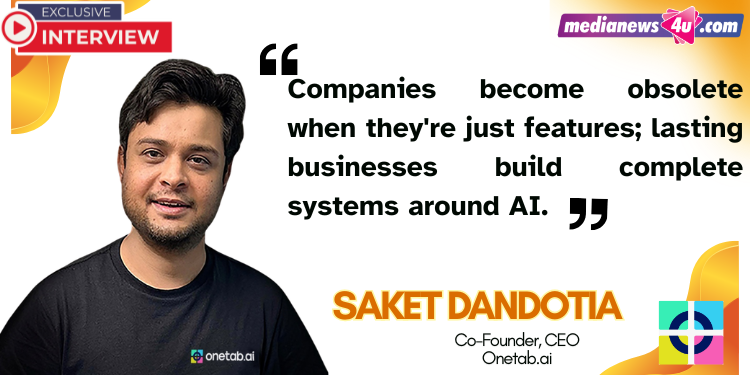
A new model release is a tailwind for us, not a threat. The companies that get absorbed are the ones that were just a thin feature. We are building the system around the model.