Liberty Shoes has launched its new Healers range, which combines all-day comfort, acupressure-led support, and versatile style across workwear, everyday, and occasion-led footwear.
At a time when conversations around wellness are expanding beyond fitness and nutrition, Healers aims to tap into an often-overlooked space: foot health and its impact on overall well-being.
Engineered at Liberty’s Humantech Centers, the range incorporates innovations like LAS-3 acupressure technology and H8 Tech, designed to stimulate key pressure points and support long hours on your feet during work, daily routines, or social occasions.
Medianews4u.com caught up with Anupam Bansal, Executive Director Liberty Shoes who shared deeper insights about the Healers range and the significance behind foot health for overall wellness.
Q. What goals have been set in 2026 in terms of revenue, growing market share and what is the gameplan to get there?
We do not announce revenue targets publicly, but the direction is clear: grow faster than the market, both in value and in reach. The gameplan is not complicated. Strengthen the product, sharpen the retail experience, invest meaningfully in digital, and keep expanding into markets where we know there is genuine demand waiting to be served.
We have multiple sub-brands operating across price points and consumer segments, and the task is to get each of them firing at full potential simultaneously. If you get the product and distribution right, the numbers follow.
 Q. Given Liberty Shoes already has a very strong presence in North India, does the whitespace for growth in 2026 lie in Tier 2 and Tier 3 markets according to predictive analytics?
Our strength in North India is real, but we have never treated it as a ceiling. The whitespace is actually across two dimensions simultaneously: deepening penetration in smaller towns in markets where we are already present, and building meaningful presence in the South and East where the opportunity is significant.
Data tells us that discretionary spends on footwear in Tier 2 and Tier 3 towns are growing faster than metros. The aspiration is there. The question is whether your distribution and product mix are ready to serve it. We are investing to ensure they are.
Q. Could you talk about the R&D that has gone into Liberty Shoes’ new Healers range, which combines all-day comfort, acupressure-led support, and versatile style across workwear, everyday, and occasion-led footwear?
Healers is a range we are genuinely proud of because it comes from a very specific consumer insight: people are on their feet for long hours and the footwear market had not adequately solved for that. The R&D behind Healers runs deep. Our Innovation Lab and HumanTech Centre have spent years studying how the foot actually behaves across extended wear, where pressure accumulates, how fatigue sets in, and what materials genuinely respond to the body. Healers is the consumer-facing result of that work.
The acupressure-led support is not a marketing claim layered on top of a standard shoe. It is engineered into the insole and midsole construction through pressure mapping, material selection, and sole ergonomics. That is what art of comfort means to us: not comfort as a default, but comfort as something genuinely crafted and scientifically built. The style element was equally non-negotiable, because a shoe that is only functional does not get worn every day. Healers had to look as good as it felt.
Q. Who is the target group for the Healers product?
The honest answer is: anyone who is on their feet for a significant part of the day and has started paying attention to what that does to their body. That spans a wide range. Healthcare workers, teachers, professionals with long office hours, homemakers who cover a lot of ground daily. Age-wise it skews 25 and above, but the need is not defined by age. It is defined by lifestyle and awareness.
As conversations around wellness have broadened beyond the gym, more consumers are thinking about their feet and posture in ways they simply were not five years ago. Healers is built for that consumer.
Q. What marketing campaigns and innovations can we expect in the coming months?
We are focussed on campaigns rooted in real consumer truths rather than aspirational fluff. For Healers, the communication covers every aspect of art of comfort: the lived experience, the science behind the construction, and the everyday moments where comfort genuinely changes how someone feels.
For Leap 7X, it is about versatility. The brand moves with the consumer across occasions and we will show that range in full. AHA and Lucy and Luke come into sharp focus as holidays and monsoon approach. We have a complete range ready for the season and the campaigns will reflect that, built around fun, movement, and style that holds up when real life gets going.
The school range follows closely, and we treat that campaign with the weight it deserves. Buying school shoes is one of the most considered purchases a family makes. Our communication will speak to both the parent and the child.
On the innovation side, we are investing in how we show up at the point of sale, how we tell the product story in a retail environment, and how we build digital touchpoints that are genuinely useful. The philosophy is consistent across everything: substance first, style in service of it.
 Q. What will the media mix look like in 2026 for this range and other products? Any change compared with 2025?
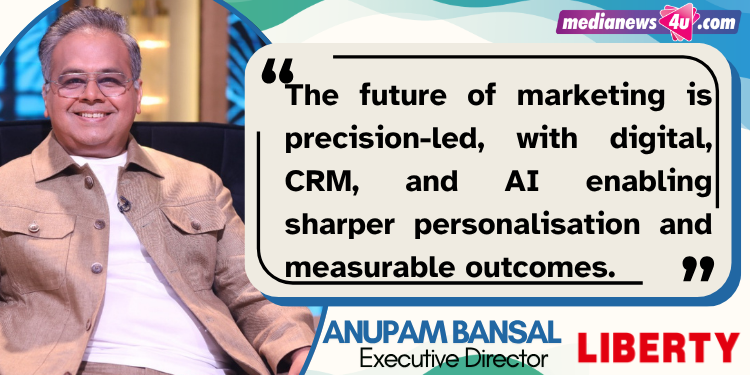
The shift that has been happening over the past few years continues to accelerate. Digital is taking a larger share, not because traditional media has become irrelevant but because digital now allows us to be far more precise about who we are talking to and what we are saying to them. Today’s customer has specific needs and is actively seeking information, so digital and content-led media make a lot of sense.
Influencer partnerships are a meaningful part of that digital mix. As we discussed, the logic is alignment over reach. The right creator speaking authentically to foot health, comfort technology, or active lifestyle delivers far more than a mass placement ever could.
We are also investing seriously in CRM. Our Step Up Club loyalty programme gives us a direct relationship with our most engaged customers. That is a channel we can use to communicate new launches, technology stories, and personalised recommendations in a way that no broadcast medium can replicate. A customer who has already trusted Liberty once is the most valuable audience we have, and Step Up Club lets us deepen that relationship meaningfully.
That said, for brand-level messaging and reach, we continue to value television and outdoor, particularly in markets where digital penetration is still building. The mix in 2026 is more calibrated than it was in 2025, with a stronger emphasis on measurable outcomes at every stage of the funnel.
Q. Legacy brands like Liberty Shoes are faced with the challenge of staying meaningful to Gen Z and Gen Alpha without sacrificing their essence. How is Liberty Shoes addressing this challenge?
I think the mistake is to frame this as a sacrifice. But let me also be honest about where we are focussed. Our core target group runs from 25 to 40. This is the consumer with real disposable income, the one who makes considered purchases and influences the spending decisions of everyone around them.
That is exactly why we are going heavy on innovation, because the investment has to result in product that is useful across age groups, not product that chases one generation and alienates another. ProTrackter gives peace of mind to a 35-year-old parent. Twist & Go works for a 28-year-old and a 55-year-old equally well. That is not an accident. We will not be caged into being a brand for one generation.
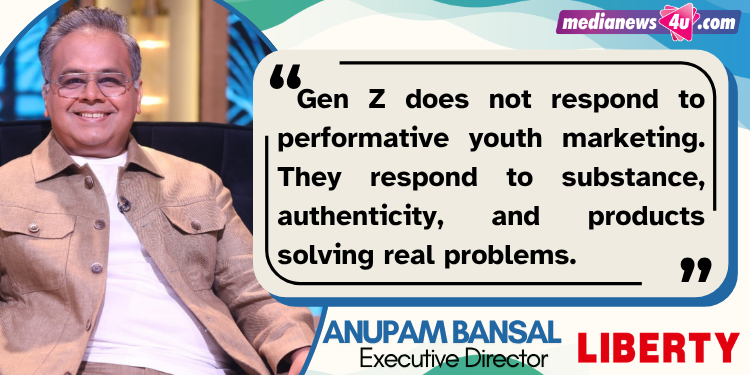
Gen Z sees through brands that perform youth. Our 25 to 40 consumer responds to exactly the same thing: substance. Liberty’s point of view has always been to make footwear that works for real people’s real lives. That is not a legacy constraint. That is a very strong foundation to build from, for any generation.
Q. Gen Z prioritises authenticity. Gen Alpha has no tolerance for mediocrity. Is this forcing legacy brands to rethink the marketing playbook?
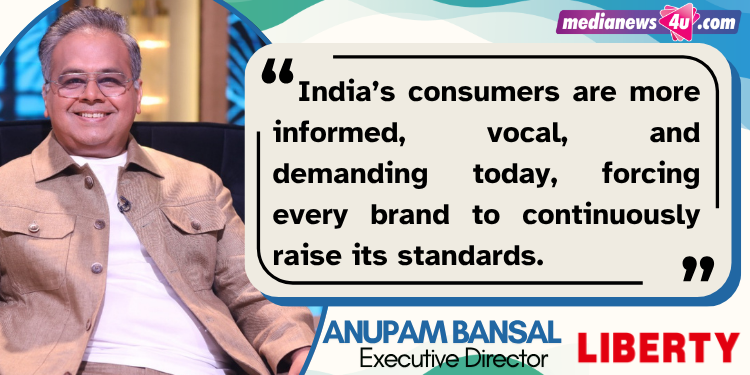
It is forcing everyone to raise their game, not just legacy brands. And the Indian consumer is evolving faster than most markets give them credit for. They are more informed, more vocal, and more demanding than they were even five years ago. The expectation bar has moved and any brand that does not move with it will find out very quickly.
The difference for a legacy brand is that you have both an asset and a liability in your history. The asset is trust and recognition. The liability is complacency, assuming that recognition will do the work that relevance used to do. The playbook has to change in how you engage, where you show up, and how quickly you respond.
But the fundamentals do not change. A mediocre product with great marketing will fail faster today than it ever did, because the Indian consumer will call it out publicly and immediately. The answer to Gen Alpha’s intolerance for mediocrity is simple: meet the demand with a product that is actually worth it. There is no shortcut.
Q. What role will celebrities like singers play in building and spreading the brand narrative?
Celebrities work when there is a genuine alignment between what they stand for and what the brand stands for. A singer who genuinely lives an active, on-the-go lifestyle and talks about wellness is a credible voice for a range like Healers and Leap 7x . A celebrity who is simply famous but has no connection to what you are saying adds noise rather than signal.
We are thoughtful about this. The era of putting a famous face on a product and expecting it to move the needle is largely over. Today it is about whether the association feels true, both to the celebrity’s audience and to our consumers.
 Q. Credibility can no longer be inherited but must be demonstrated time and again. How is Liberty Shoes strengthening credibility through brand narrative and product innovations across categories in 2026?
That is exactly the right way to put it. Sixty-five years of history gives you a starting point in a conversation, not the conclusion. Every season, every new range, every campaign is an opportunity to either reinforce that credibility or erode it. We strengthen it by not overpromising. By making sure the product in the box delivers what we said it would.
By being present and responsive in markets rather than distant and corporate. Our Innovation Lab and HumanTech Centre have been doing the hard technical work for years, and in 2026 we are being more deliberate about communicating that work to consumers, because they deserve to know what goes into the product they are buying.
Q. How has AI been integrated into Liberty Shoes including in the marketing function?
AI is being used across several parts of the business. In marketing, the most immediate application is in how we use data to understand consumer behaviour and personalise communication. We are also using AI tools in content creation workflows, in demand forecasting, and in improving how we manage inventory across our retail network.
I will be honest and say we are still learning, still building the capability. But we are building it with intention rather than just chasing the trend. The goal is to use AI where it genuinely improves a decision or a customer experience, not to use it for the sake of saying we do.
Q. Is AI making it easier to balance performance marketing with brand building?
Yes, in a very practical sense. Performance marketing has always been easier to justify because you can measure it directly. Brand building has always been harder to defend in a quarterly conversation because the returns are longer and less linear. AI is starting to close that gap by helping us model the contribution of brand equity to downstream performance metrics.
When you can show a clearer link between brand investment and conversion efficiency, the conversation about balance becomes much more rational. We are not fully there yet, but the tools are improving and the thinking is improving with them.
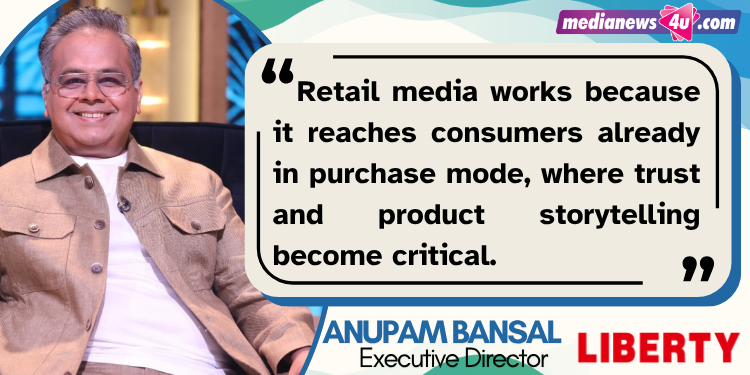
Q. How will Liberty Shoes fine-tune its retail media strategy in 2026 through a presence on platforms like Amazon and Flipkart?
Retail media is one of the more interesting spaces right now because it puts your brand in front of a consumer who is already in a purchase mindset. Our focus on Amazon and Flipkart in 2026 is on three things: making sure our product pages are doing the full job of communicating value and not just listing specifications; using sponsored placements intelligently based on search behaviour and category trends; and building reviews and ratings as a genuine trust signal rather than a vanity metric.
We are also paying close attention to how these platforms are evolving their ad products, because what was available in 2024 looks quite different from what is available now.
Q. How will Liberty Shoes leverage the creator economy by working with influencers at a time when conversations around wellness are expanding beyond fitness and nutrition?
This is an area where Healers and Leap 7X both have a natural opening, but for very different reasons.
For Healers, wellness conversations have moved well beyond the gym and the nutrition label. People are talking about sleep, posture, stress, foot health, energy levels across the day. The art of comfort positioning sits right at the centre of that expanded conversation. Technologies like HG, HA, and H8, built into Healers to deliver genuine foot health support, are shareable in a wellness context in a way that most footwear simply cannot claim. A physiotherapist with 80,000 followers who talks about foot health every week is more valuable to us than a lifestyle influencer with five million who has no connection to what we are selling.
For Leap 7X, the creator profile is completely different. NitPro’s featherlight cushioning sitS naturally with movement-oriented creators, runners, streetwear enthusiasts, and young urban professionals who document their active lives. The conversation there is energy, performance, and style that keeps up.
Across both, we are not chasing follower counts. We are looking for genuine alignment between what the creator stands for and what the product actually delivers. Without that match, it is just another paid post the audience scrolls past.
 Q. Is hyper personalisation growing in importance for Liberty Shoes in 2026?
It is, and it has to be, because the consumer increasingly expects it. Someone who has bought from Healers should not be receiving generic Liberty communication. Someone who shops in our kids category should be getting content relevant to that journey.
We are building the data infrastructure and the CRM capability to make that possible at scale. It is not something you can do overnight and it requires discipline in how you collect and use data responsibly.
But the direction is clear. Mass communication still has a role for brand building, but the relationship with an individual consumer, especially in digital channels, needs to be far more specific and useful to them.