Mumbai: McCann has released its latest global study, The Truth About Global Brands, revealing a major shift in how brands earn relevance and drive growth in an increasingly complex and AI-driven world. The research highlights that in India, 73% of consumers believe it is more important than ever to prioritise truth, signalling a growing demand for authenticity, transparency and trust from brands.
The study surveyed 20,713 people across 20 markets and incorporated independent B2B insights from Economist Enterprise, the business-to-business arm of The Economist Group.
At a time when artificial intelligence is reshaping decision-making, consumer trust is becoming fragmented and cultural influence is increasingly multi-directional, the report argues that brands must help people navigate what McCann calls the “Truth Maze” — an environment defined by conflicting information, AI-generated content and competing narratives.
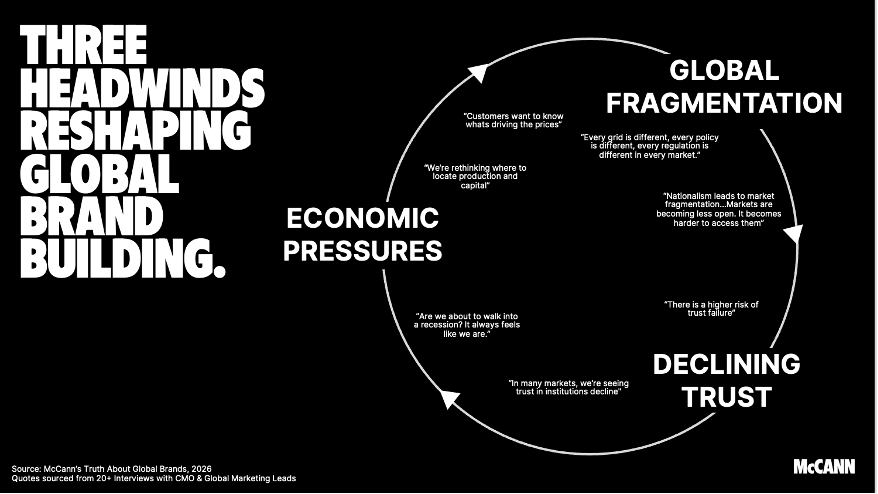
According to the findings, 46% of people in India believe brands are less truthful today than they were 20 years ago, while 71% worry they may soon be unable to distinguish between real people and artificial ones online.
Commenting on the findings, Tyler Turnbull, Global CEO, McCann, said, “Global brands are experiencing a growth crisis as we’ve shifted from a trust economy to a doubt economy, putting CMOs under more pressure than ever. The new playbook for the future of brand building will be grounded in a brand’s ability to show up with clarity, credibility and cultural fluency at every decision point.”
The research suggests that while AI adoption is becoming essential, accountability and transparency will define the next phase of brand trust.
Globally, 72% of consumers and 88% of B2B leaders believe brands must adopt AI to remain competitive. In India specifically, 57% of respondents say transparency about AI usage is the most effective way for brands to build trust, while 49% expect brands to help distinguish between real and AI-generated content.
The report further underscores the direct commercial impact of trust.
Harjot Singh, Global Chief Strategy Officer, McCann, said, “In a world where truth matters more than ever, certainty is the new value exchange.”
Supporting this view, the findings show that 88% of Indian consumers are willing to actively choose trusted brands even at a higher cost, demonstrating a growing premium attached to credibility.
At the same time, 71% of Indian consumers and 79% of global B2B decision-makers reported discontinuing a brand because they no longer trusted it

Reflecting on the implications for business decision-makers, Tamara McMillen, Chief Revenue Officer at Economist Enterprise, said, “The data tells a compelling story: when business leaders lose faith in a brand, they walk away and they don’t come back easily. What this means for global brands is that the commercial cost of doubt is real and measurable. Brands that invest in being trustworthy guides to B2B decision-makers are the ones best positioned to grow.”
The study also points to a broader transformation in global influence patterns, introducing the concept of “Multi-Modal Globality,” where cultural influence no longer flows from established global markets alone.
Markets such as India, China and Saudi Arabia are increasingly shaping global conversations, with 79% of Indians believing they can be global citizens without travelling.
Another key insight from the report is the emergence of a new growth audience — the “Upward Class.”
Defined as a globally connected and aspirational consumer group, the segment comprises:
1.02 billion people worldwide
$29.5 trillion in annual spending power
Consumers driven by self-improvement, progress and upward mobility
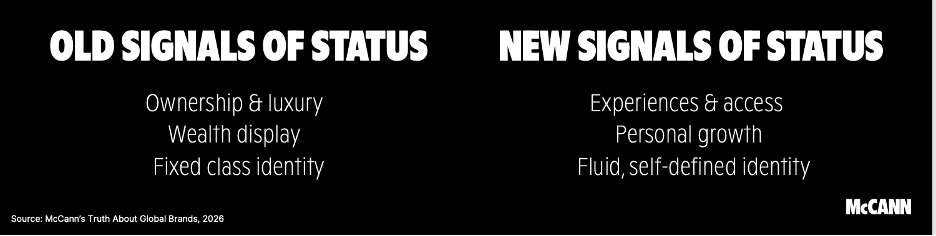
According to the report, this audience views brands not merely as products but as markers of progress, identity and belonging.
Summing up the findings, Turnbull added, “Future growth won’t come from leaning on existing audiences or legacy markers of scale. It will come from brands that turn truth into a genuine growth engine, building connected systems of meaning, culture and commerce. That’s what McCann’s Truth Well Told framework is designed to do.”
The report concludes that brands seeking growth in 2026 and beyond will need to move beyond messaging volume and focus instead on reducing uncertainty, delivering proven value, and creating culturally connected ideas that scale across markets and communities.