Medianews4u.com caught up with Vaibhav Gupta co-founder, chief product officer KlugKlug following the company’s recent analysis of the rapidly evolving AI influencer landscape.
Some key insights from the report:
- 1,155 AI influencers are currently active globally.
- 190 are based in India, making it one of the fastest-growing markets for virtual creators.
- AI creators are already being used for content at scale, always-on brand presence, and cost-efficient marketing campaigns.
- Several AI influencers are recording impressive engagement metrics, including:
- Naina – 4.05% engagement rate with 92.17% engager credibility.
- Vijay Koliwad – 225K+ followers and 10.27% engagement rate.
- Lu do Magalu – 9.2 million followers with 92% engager credibility.
- Kyra – India’s first AI influencer with 235K+ followers.
- Noonoouri – 461K+ followers and collaborations with luxury brands like Gucci and Dior.
Q. How did you track down exactly 190 AI influencers in India? What clues told your platform these accounts weren’t real people?
Our engine already scans north of 300 million profiles across 150-plus countries, so the question for us wasn’t “where are they” but “how do we separate a synthetic persona from a human one at scale.” Virtual creators leave fingerprints, and a lot of it is right there in how they describe themselves.
We looked at the bio tags, the way they self-identify, the hashtags they lean on, and the themes they build their content around. Virtual and AI creators cluster very distinctly on all of these. Put together, those patterns separate a synthetic persona from a human one far more reliably than any single signal. The 190 is simply the count of active, genuinely followed virtual personas operating in the Indian market right now.
 Q. Was there a specific moment or campaign that made everyone realise AI creators are serious business?
It was a cluster of moments. Globally, Lu do Magalu and Lil Miquela made brands comfortable with the idea.
In India, characters like Naina and Kyra moving from novelty to actual brand tie-ups were the turning point, particularly in beauty and fashion, which are always the first movers.
Q. You found a virtual creator like Vijay Koliwad has a 10% engagement rate. How do you know his followers aren’t just bots talking to another bot?
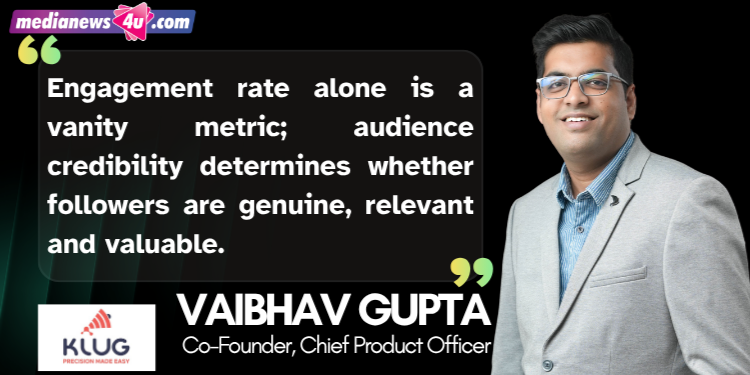
Engagement rate on its own is a vanity number to us; we never stop there. We score the credibility of the audience. A real 10% and a bot-inflated 10% look nothing alike under the hood: audience geography and audience split are very telling.
What matters is that we run credibility checks at two levels, not just the audience in aggregate, but each individual influencer. For any given creator, we can see roughly how much of their following and engagement is genuine versus bots and mass followers or mass engagers. So when we say an audience is credible, it’s because we’ve broken down exactly who’s on the other side.
Q. If the creator is made of code, and fake followers are made of code, how does KlugKlug prove to a brand that humans are actually watching and care?
Simple, we don’t measure the avatar, we measure the audience. Whether the creator is a person or a rendered character is almost beside the point.
What matters is who’s on the other side of the screen, and that’s where our follower-credibility scoring and real-engager analysis come in. A synthetic creator can still command a very real, very human audience.
Q. Why would a regular person want to follow a robot instead of a human? What’s the psychological reason?
A virtual creator is aspirational, always on-brand, and never has a bad day or a controversial tweet from 2015. For a digital-native audience that grew up inside games and CGI, there’s no friction in following a character, it’s entertainment.
There’s also a parasocial comfort to it: closeness without the unpredictability of a real person. That said, I always add my caution here , how much candy can you eat in a day? When everything is perfect, perfectly lit and perfectly scripted, people eventually crave rawness and human connection. That pendulum always swings back.
Q. If a virtual creator promotes a skincare product that breaks people out, who gets taken to court: the brand or the tech team who built the avatar?
I’m not a lawyer, so take this as the framework rather than legal counsel. In India, ASCI places primary responsibility for a claim on the advertiser, the brand. The creator, human or virtual, is obliged to disclose the material connection, and ASCI has been clear that influencers must be disclosed as such.
So a misleading efficacy claim lands first on the brand that made it; the studio operating the avatar carries responsibility for disclosure and for how the message was delivered.
 Q. Why are Indian brands moving away from big Bollywood stars toward niche creators? Why spend on a small creator when a celebrity has millions of fans?
Because reach and relevance are not the same thing, and brands finally have the data to see the difference. A celebrity gives you a billboard; a niche creator gives you a conversation with an audience that actually converts.
I trust a creator with around 15,000 real followers more than many mega-names. Micro and nano creators drive depth, credibility and far better cost efficiency. You’re not buying fame; you’re buying belief.
Q. How does a brand build a “portfolio” of creators? What does that look like for a local brand?
Think of it like a media plan, not a one-off booking. You blend tiers, a few macro creators for reach, a strong base of micro and nano creators for depth, and you deliberately avoid audience
overlap so you’re not paying three times to reach the same people.
For a local brand it gets very specific: creators based in your city, whose followers are also in your city, matched to your category affinity. One or two always-on creators who become genuine brand voices, plus campaign bursts around launches, increasingly on affiliate or performance terms. That mix is the portfolio.
Q. Are brands actually paying influencers based on sales now?
Increasingly, yes. The pure flat-fee-for-a-post model is giving way to hybrids, a base fee plus performance-linked or affiliate payouts tied to actual sales. E-commerce made this measurable, and once you can attribute a sale to a creator, the conversation naturally shifts from “what’s your rate” to “what did you deliver.”
It’s healthier for everyone, because it rewards the creators who genuinely move product.
Q. If AI influencers are cheap, don’t sleep, and speak 20 Indian languages perfectly, doesn’t that shrink the human influencer economy?
I genuinely don’t think it shrinks it, I think it expands the pie and splits it differently. AI is unbeatable for scale, localisation and experimentation: twenty languages overnight, no logistics. But the thing humans have is lived credibility, the “I actually used this” trust, and that exactly what audiences crave more of when everything else becomes synthetic.
The future is hybrid: AI for reach and boundary-pushing creative, humans for depth and belief. The candy point again, a feed of nothing but perfect virtual creators eventually leaves people hungry for something real.
 Q. If a brand wants to stay ahead of the curve next year, what’s the one thing they should start doing today?
Stop buying reach and start buying audience intelligence. The single highest-return move is to stop selecting creators by follower count and start selecting by audience composition, who genuinely follows them, whether those people are your actual target, and whether they’re real.
Brands that build that discipline now, and measure the 75% of spend that currently goes untracked, will quietly outperform everyone still chasing big numbers next year.