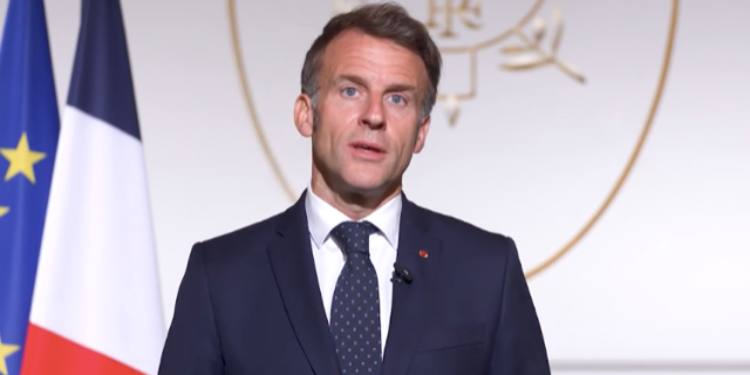
Cannes, France: When Emmanuel Macron addressed the closing night of the Cannes Lions International Festival of Creativity via video on Friday evening, he was doing more than accepting a trophy. He was making a pitch — and a carefully choreographed one at that.
France’s designation as the 2026 Creative Country of the Year is, on one level, a well-deserved recognition of a nation with an unimpeachable cultural pedigree. On another, it is a geopolitical moment Macron has no intention of letting pass quietly.
“French creativity is a national philosophy,” the President told delegates gathered for the festival’s prestigious awards show in Cannes. It was a line that could have come from a tourism brochure. But the broader context of Macron’s address made clear that what he was selling was something more substantial: France as the most competitive creative and investment destination in Europe.
From Culture to Capital
The speech was notable not simply for its rhetorical flair — Macron is rarely short of that — but for the hard economic infrastructure it placed behind the cultural argument. He cited France’s ranking as the most attractive country for foreign investment in Europe for the seventh consecutive year, a statistic his government has leaned on heavily in recent months.
Behind that figure lies deliberate policy. Macron referenced a programme of labour reforms, large-scale innovation investment and regulatory simplification, framing these structural changes as the essential preconditions for creative freedom. “This is key to free up time for creativity,” he said — a framing that neatly bridges the gap between economic liberalism and cultural aspiration.
The numbers he cited give the rhetoric substance. The France 2030 initiative has directed €350 million in government funding toward domestic film production, a significant intervention in an industry that has long battled the gravitational pull of US and UK studio infrastructure. Meanwhile, at the Choose France summit earlier this month, foreign companies pledged €93 billion in investment — concentrated heavily in AI and data — signalling that the creative economy and the technology economy are, for Paris at least, increasingly the same conversation.
A Festival Platform, A National Brand
The choice of Cannes Lions as a venue for this kind of address is telling. The festival sits at the intersection of creativity, commerce and media — precisely the triangle Macron has been working to position France within. Citing achievements spanning the 2024 Paris Olympics and the country’s video game industry in the same breath as Cannes and Dunkirk, he was drawing a map of a France that is simultaneously culturally sovereign and economically open.
This is the balancing act French industrial policy has long attempted — and one that other European nations watch with a mixture of admiration and scepticism. Can a country genuinely brand itself as both the home of irreverent, poetic creativity and a reliable, reform-minded destination for foreign capital? Macron’s wager is that not only can it, but that the two are mutually reinforcing.
Looking Ahead: The Lumière Summit
Macron used the closing moments of his address to extend an invitation to the Lumière Summit, scheduled for 7 September at the Fondation Maeght in Saint-Paul-de-Vence — a detail that will not be lost on those who note the careful aesthetic curation of French statecraft. The summit, co-chaired by France and South Korea, is dedicated to cinema, television series and video games, and signals Paris’s intent to anchor international conversations around content creation, not merely consume them.
The France-South Korea pairing is itself noteworthy. South Korea’s emergence as a global cultural force — accelerated by the worldwide appetite for K-drama and K-pop — makes it a credible and symbolically potent partner for an initiative that seeks to reframe European creative soft power.
The Bigger Picture
For the business community, the message from Friday evening is clear: France is not resting on cultural laurels. The Cannes Lions award, flattering as it is, is being leveraged as a launchpad rather than a finishing line.
Whether the investment pledges translate into sustained activity, whether the regulatory reforms hold, and whether France’s creative sector can genuinely compete at scale with the production infrastructure of the US and the UK — these are questions that will be answered over years, not award cycles.
But Macron, characteristically, is not waiting for those answers before making the case. In Cannes, on the closing night of the world’s most influential creativity festival, he made it loudly and with evident conviction.
“You will see,” he told the assembled industry, “that we can go further and be even more creative.”
For France’s competitors — and its potential investors — that is probably the line worth taking seriously.