Mumbai: The global retail media market continues to display strong momentum, with ad investment projected to surpass $200 billion by 2027, according to the latest WARC Media report. However, the industry’s “gold-rush” phase is showing signs of maturity as growth in sponsored search slows, prompting retailers to evolve into ‘full-funnel’ platforms that combine on-site, off-site, and display solutions powered by AI.

“Retail media has evolved from a US and China-driven trend into a global phenomenon, with European spend now growing at double the rate of the broader digital advertising market,” said Alex Brownsell, Head of Content, WARC Media. “As the sector expands beyond traditional sponsored search into visual display, audio, social, and television partnerships, it has never been more important for advertisers to have clarity on the scale and the suitability of the commerce media opportunity.”
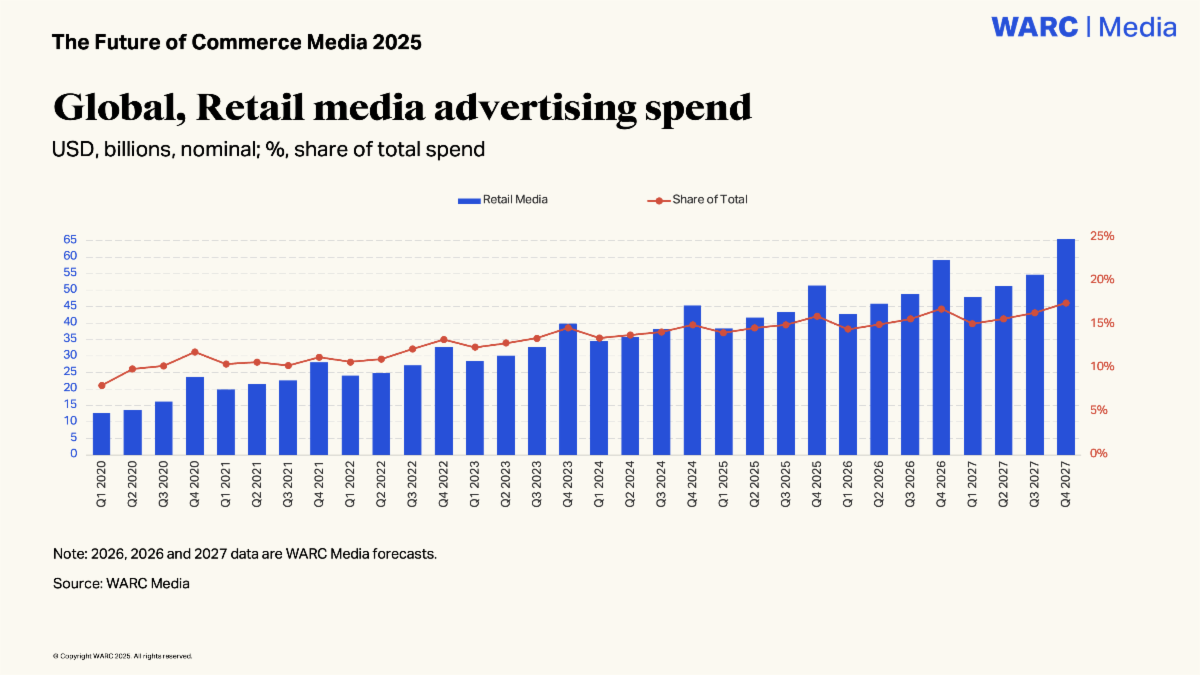
Retail Media Ad Market Nears $200bn
According to WARC Media, global investment with retail media networks (RMNs) is set to reach $174.9bn in 2025, marking a 13.7% year-on-year rise, and is forecast to grow another 12.4% in 2026 to hit $196.7bn, accounting for 16% of all ad spend.
However, topline growth rates are slowing—down from 38.6% in 2021 to a projected 11.6% in 2027, signalling a shift towards consolidation and maturity.
James McDonald, Director of Data, Intelligence & Forecasting, WARC, noted, “Retail media is rapidly evolving from a lower-funnel, search-dominated channel into a full-funnel proposition. Display advertising currently represents less than 30% of total on-site retail media spend, however, this balance is poised to shift as retail media becomes more integrated with brand digital budgets. Much may depend on the adoption of agentic AI, which threatens the high human traffic volumes that have monetised the retail media networks to date.”
Key findings from WARC Media include:
- Retail media ad investment is forecast to overtake combined linear and connected TV spend in 2026.
- Spending growth from endemic brands is decelerating, while technology and electronics remain the largest category, expected to hit $32.2bn globally in 2026 (up 15.4% YoY).
- Display and off-site advertising are driving future growth; UK display retail media spend grew 41.6% YoY in H1 2025.
- Quick-commerce (q-commerce) platforms such as Instacart, Uber, Delivery Hero, and DoorDash each boast annual ad businesses exceeding $1bn.
- Scale will determine RMN viability as advertisers become more selective amid market deceleration.
- Tariff concerns drove an early surge in retail media spend in Europe during H1 2025.
Commerce Media Becomes a Full-Funnel Proposition
The study highlights that commerce media is now seen as a full-funnel solution capable of supporting brand awareness, engagement, and conversion. A survey by Infillion revealed that 40% of agency executives view retail media as a full-funnel channel, with 7% identifying upper-funnel potential.
However, the report cautions that new success metrics are needed beyond ROAS to measure broader outcomes like brand lift and customer lifetime value. Emerging formats such as CTV, off-site, DOOH, and in-store ads are enabling truly integrated strategies bridging digital and physical retail.
Amazon Expands Its Open-Web Advertising Dominance
Amazon, the world’s largest commerce media player, continues to dominate with 15% year-on-year growth, driven by full-funnel DSP partnerships. Its inventory now includes Roku, Disney, Netflix, Spotify, and Microsoft, expanding reach to over 300 million ad-supported users in the US and 80% of UK households via its DSP.
Research from Skai found that over 20% of Amazon ad spend is now allocated to DSP, double the share from two years ago, reflecting advertisers’ demand for efficiency and reach.
Agentic AI Commerce Arrives
The next frontier, agentic AI commerce—shopping powered by autonomous AI agents—is creating new disruption. The total addressable market stands at $136bn in 2025, expected to soar to $1.7trn by 2030, according to Edgar, Dunn & Company.
The report advises brands to adopt test-and-learn strategies with a focus on meeting real consumer needs, not just deploying new technology. It also stresses that AI-driven results should be assessed holistically, acknowledging the influence of brand equity, creative, and seasonality.
The Future of Commerce Media 2025 combines WARC Media’s proprietary data with external insights to explore the next evolution of retail and commerce media. WARC members can access the full report, with a dedicated deep-dive podcast to follow.