Overview: Mid-Season Reality Check for IPL Advertising
At the halfway stage of IPL 2026, the latest VR Score™ (Visibility & Recall) data from the SCORE IPL Ad Effectiveness Solution, developed by Synchronize India and powered by the Unomer, offers a more stable and revealing picture of brand performance. Based on a sample of over 24,300 viewers across 70+ cities, the rankings capture how sustained exposure, media mix, and creative consistency are shaping brand recall beyond the early tournament burst. Unlike the 10-day snapshot, which reflected initial visibility spikes, the 4-week data highlights which brands have managed to convert presence into persistence, and visibility into memory.
Top Order Tightens as Google Surges
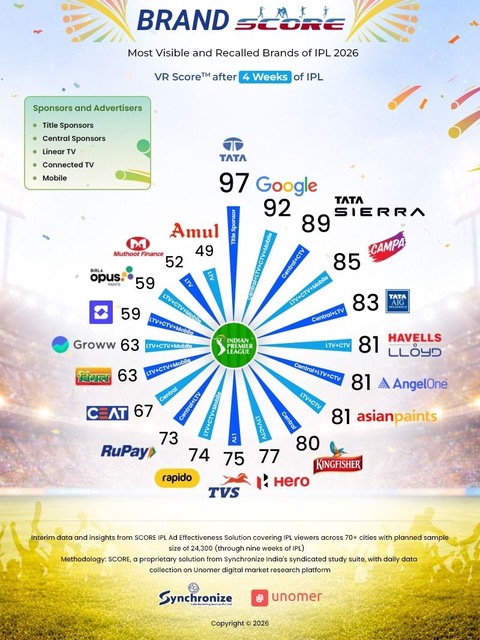
The leaderboard continues to be led by TATA, which has further strengthened its position with a VR Score of 97, up from 95 in the early phase. However, the bigger story lies just beneath. Google has surged to a score of 92, marking a sharp rise from its earlier position and narrowing the gap with the title sponsor to just five points. This shift signals that even the most dominant sponsorship advantage can be challenged through sustained, high-frequency, multi-platform campaigns over time.
Close behind, Tata Sierra at 89 and Campa at 85 have emerged as strong contenders in the upper tier, reflecting aggressive campaign scaling and effective recall-building strategies. The next layer of competition is tightly packed, with TATA AIG at 83 and a cluster comprising Havells Lloyd, Angel One, and Asian Paints all at 81, indicating how competitive the upper-mid tier has become as brands converge around similar recall levels.
Momentum Emerges as the Defining Metric
If the early days of IPL 2026 were about securing visibility, the mid-season data makes it clear that momentum is now the defining currency. Brands that have managed to accelerate their presence over time are seeing disproportionate gains in recall. A notable example is Super Money, which has climbed from a relatively low rank of 27 to 17 within just three weeks. This kind of movement is not merely a function of increased media spends, but a combination of consistent messaging, improved creative recall, and better integration across platforms. The implication is clear: IPL advertising success is no longer determined by entry position alone, but by the ability to build and sustain acceleration.
For the first time in recent IPL cycles, the data suggests that leadership positions are no longer insulated. While TATA continues to dominate, the rapid rise of Google indicates that the gap between title sponsorship-driven visibility and performance-led advertising is shrinking. The five-point difference between the top two brands is relatively narrow in the context of VR Score dynamics, especially with half the tournament still remaining. This introduces a new layer of unpredictability, where sustained campaign pressure and smart media deployment could potentially reshape the top order before the season concludes.
The IPL Advertising Playbook Is Now Clear
Despite the shifts in rankings, the underlying playbook driving success has become increasingly consistent. Linear television continues to act as the primary engine of scale, with 16 of the top 20 brands maintaining a strong presence on LTV. This reinforces the idea that, even in a fragmented media landscape, television remains the backbone of mass reach during marquee events like the IPL.
At the same time, mobile has established itself as a critical multiplier rather than a standalone driver. No brand in the top rankings is relying solely on mobile-led strategies; instead, mobile serves to reinforce and extend campaigns initiated on television. This layered approach ensures higher frequency and recall across touchpoints.
Another key factor shaping outcomes is integration. Brands that are part of broader sponsorship ecosystems or have integrated deals with broadcasters are quietly outperforming those relying purely on spot advertising. This shift suggests that deeper partnerships and contextual visibility are becoming more valuable than isolated ad placements.
Creative Reality Check: More Frequency, Less Differentiation
While media strategies have evolved and become more sophisticated, the creative landscape tells a more uniform story. The tournament is witnessing a surge in shorter ad formats, increased repetition, and continuous presence across matches. While this ensures high recall through sheer frequency, it also leads to a homogenisation of messaging. As a result, many brands are becoming visible without necessarily becoming distinctive. This raises an important question for the second half of the IPL: whether brands will continue to prioritise recall efficiency or invest in creative differentiation to stand out in an increasingly crowded environment.
Mid-Tier Stability and Lower-Tier Challenges
Beyond the top cluster, the rankings reveal a relatively stable mid-tier, where brands such as Kingfisher at 80, Hero at 77, and TVS at 75 continue to maintain consistent recall. Emerging players like Rapido at 74 and RuPay at 73 are also gaining traction, indicating steady but incremental growth. However, the lower end of the spectrum highlights the challenges of limited visibility and inconsistent presence. Legacy brands such as Amul, with a score of 49, and Muthoot Finance at 52 lag behind, underscoring the fact that strong brand equity alone is insufficient without sustained IPL-specific advertising pressure.
Comparative Snapshot: 10 Days vs 4 Weeks
A comparison between the 10-day and 4-week VR Score rankings reveals both continuity and change. TATA has not only retained its leadership but has marginally extended its lead, reinforcing the enduring impact of title sponsorship. Google’s sharp rise from the earlier phase to a solid second position reflects the effectiveness of sustained multi-platform strategies. Brands like Campa and Tata Sierra have moved up the hierarchy, indicating successful mid-season scaling, while the mid-tier has become more tightly clustered, suggesting increased competitive parity. At the same time, the lower tier continues to exhibit volatility, with some brands losing relative visibility due to inconsistent exposure.
Overall, the transition from early-stage visibility to mid-season stability highlights a key shift: initial bursts of advertising are no longer sufficient, and long-term consistency is now critical to maintaining and improving recall.
A Tournament Still in Play
At the halfway mark, IPL 2026 presents a more competitive and dynamic advertising landscape than in previous years. TATA remains the dominant force, but the rapid ascent of Google and the emergence of momentum-driven brands indicate that the leaderboard is far from settled. The convergence of television scale, mobile amplification, and integrated partnerships has solidified into a clear formula for success.
As the tournament progresses into its second half, the focus will shift from gaining visibility to sustaining it, and from maintaining presence to creating distinction. In this evolving landscape, the brands that can combine scale with strategy and frequency with freshness are likely to define the final outcome.
In IPL 2026, visibility may get brands noticed, but it is sustained momentum that ensures they are remembered.