Mumbai: WARC has released its 2026 Global Consumer Trends Report, highlighting how financial pressures and geopolitical uncertainty are reshaping consumer behaviour, with spending increasingly shifting toward affordable, joy-driven “small comforts.”
Based on global surveys by GWI alongside WARC’s own research and analysis, the report identifies five key trends influencing brand selection: comfort consumption amid uncertainty, the rise of AI companionship, restrictions on youth social media access, evolving perceptions of ‘Made in China’ products, and growing demand for transparency in AI-generated content.

Stephanie Siew, Senior Research Executive, WARC, says, “Consumer sentiment in 2026 remains fragile, shaped by financial pressures, geopolitical turbulence, and a growing need for escape, with spend shifting to small comforts that bring joy. Brands that forge emotional connections will thrive, but must navigate rising scrutiny on technology, authenticity, and trust to make a meaningful impact.”
“Our annual Consumer Trends report provides a broader view of the major issues confronting our industry from the perspective of consumers, with suggestions to help businesses create the most impact in the year ahead.”
The report highlights that ongoing macroeconomic volatility and job insecurity are driving cautious spending patterns. Nearly 45% of employed consumers are concerned about job security, while one-third are cutting back or saving more. As a result, consumers are prioritising low-cost indulgences such as wellness, hobbies, and everyday experiences that offer emotional relief.
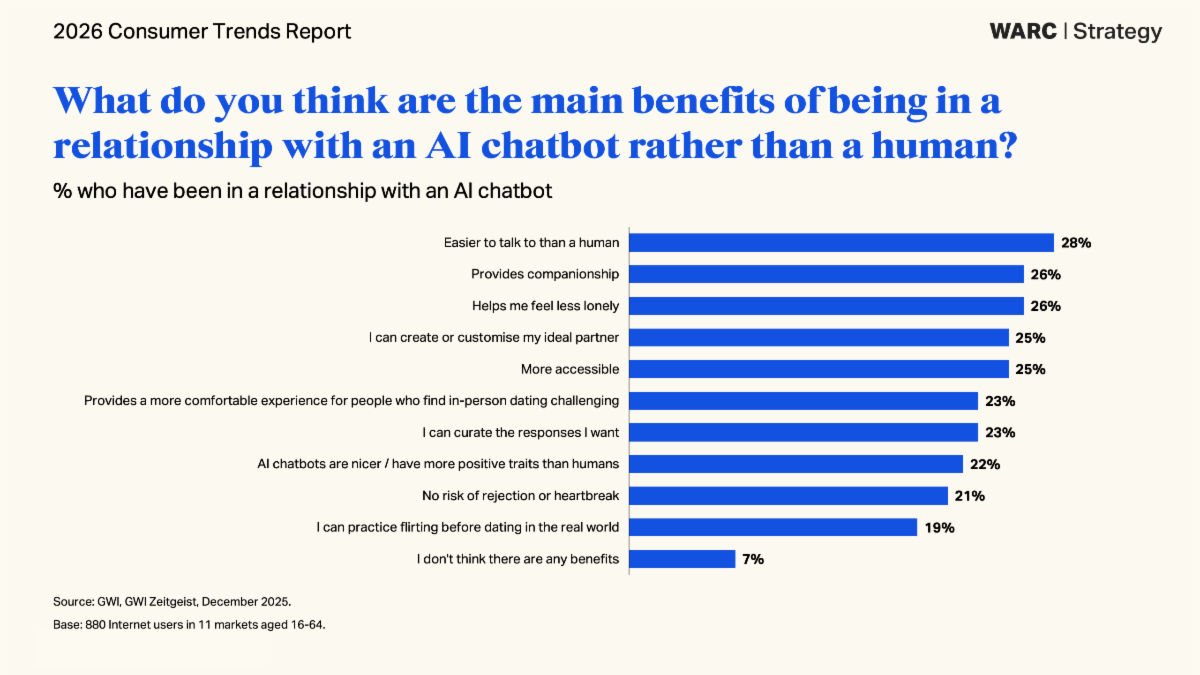
At the same time, artificial intelligence is reshaping human interaction. The report finds that one in ten consumers globally has been in a relationship with an AI chatbot, with many turning to AI for companionship and personal advice. This shift is driving innovation in AI-powered products and services, while also raising concerns around safety and ethical use.
The study also points to increasing scrutiny of social media, particularly among younger audiences. Around 64% of consumers believe social media is harmful to children, with growing support for stricter regulations and age verification. This could reshape how brands engage with younger demographics, pushing marketers to explore alternative platforms and build controlled brand ecosystems.
In parallel, perceptions of ‘Made in China’ products are evolving, especially in technology and consumer electronics. Around 36% of consumers now associate Chinese products with innovation, while one in four prefer purchasing electronics from China, reflecting a shift from price-driven to value-driven perceptions.
The report further highlights rising concerns around the proliferation of AI-generated content. While some consumers see creative potential, a majority emphasise the importance of authenticity, with 78% calling for clear labelling of AI-generated material.
Overall, the findings underline a changing consumer landscape where emotional connection, trust, and transparency are becoming critical differentiators for brands navigating an increasingly complex global environment