With the recent policy and industry conversations around India’s Orange Economy, AVGC ecosystem, and the growing role of AI in content creation, Medianews4u.com caught up with IndieVisual, a technology-led video production company that is rethinking how brands create content in today’s high-volume, digital-first environment.
Founded in 2021, IndieVisual works with enterprises and fast-growing brands to move video production away from fragmented, campaign-led execution towards scalable, always-on models. Through its proprietary platform and tech-enabled workflows, the company helps marketing teams produce consistent, high-quality video content faster, across formats, regions, and languages.
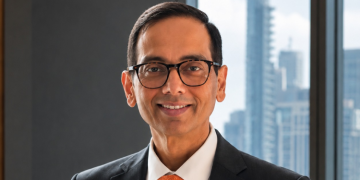
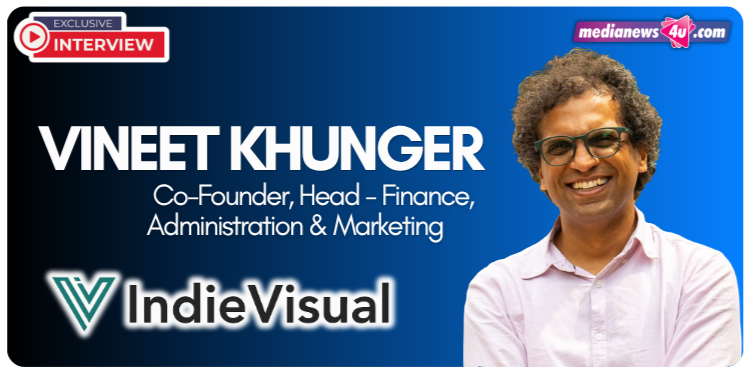
Vineet Khunger has been serving as Co-Founder and Head – Finance, Administration & Marketing at IndieVisual. He works closely across business strategy, operations, and marketing, helping shape how IndieVisual supports brands with consistent, tech-enabled video creation across markets.
With over two decades of professional experience, Vineet has worked across media, infrastructure, and technology-led organisations, building a strong foundation in enterprise marketing and operational leadership. Prior to co-founding IndieVisual, he has held roles with organisations such as Times of India, NDTV, and Saab, where he was involved in marketing strategy, business operations, and early-stage growth initiatives.
At IndieVisual, Vineet brings this cross-industry experience to support clients in moving away from fragmented, project-based production models towards more streamlined and repeatable video workflows. His work focuses on aligning content production with business needs, ensuring efficiency, predictability, and scalability across campaigns and formats.
He is an alumnus of IIM Bangalore and holds a Bachelor’s degree in Information Technology from the College of Business Studies.
Outside of work, he enjoys reading and occasionally writing about the cultural and business implications of emerging technologies, including AI, to better understand their potential impact on the future. He’s also a hobbyist pet photographer.
Medianews4u.com caught up with Vineet Khunger, Co-Founder, Head – Finance, Administration & Marketing, IndieVisual.
Q. IndieVisual works with enterprises and fast-growing brands to move video production away from fragmented, campaign-led execution towards scalable, always-on models. What does this entail?
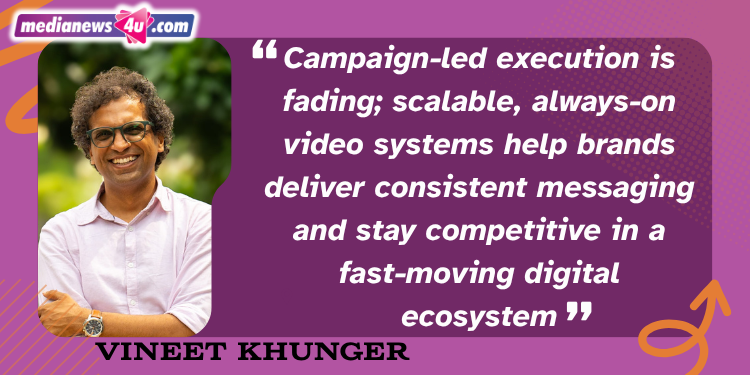
The landscape for video, and even marketing has shifted, people’s attention spans are shorter, they’re consuming much more media than ever before. Also, algorithms determine what people see, rather than mega events that everyone is tuned in to. So, campaigns don’t have the lasting power they used to. This means that brands need to constantly be plugging in new content, to retain any semblance of top-of-mind recall with their customer. That’s why campaigns are now pretty much “always on”, you need new video and new marketing materials constantly.
A digital-first world works very differently from a TV or print-first world, and brands need to have a simple, effective, reliable way of producing new videos all the time.
Q. How much R&D goes into its proprietary platform and tech-enabled workflows?
We’ve spent four years building a video production management system from the ground up, that covers the complete video workflow, right from the campaign brief, all the way to the final edit, and every single step in between. That’s what helps us do in six days what would otherwise take 30.
Q. What role is AI playing in the company helping marketing teams produce consistent, high-quality video content faster, across formats, regions, and languages?
AI has come a long way in the last couple of years. When it comes to regional content, including voiceovers, scripts, etc, it’s still not completely reliable, it misses nuance, it misses cultural context, it gets too literal with its translation, and it’s inconsistent. Having said that, it’s a huge boost as a starting step, it can massively speed up a good translator or a good content writer, for example.
Q. What is the company’s business model? How is the business model being fintuned? What goals have been set for 2026 in this regard?
Think of video production as a combination of the mundane, the technical, and the creative. As a business, we’re building infrastructure for video production that automates the mundane, that streamlines the technical, and that brings together the best of the creative world, all with the goal of creating a great video that aligns with a brand’s vision. So, in a way our business models are incredibly straightforward, translate the brand’s vision into a great video, in a streamlined and simple manner, for a transparent price.
With AI video getting better and more photorealistic, we’re building tools and systems that will give marketing teams the ability to do a lot more by themselves, without even having to reach out to us for their bread-and-butter campaigns, and come to us for the more advanced videos that require creative expertise that a brand team might not have in-house. So, our goal is to bring together, and build on top of, the best video production technology in the world.
Q. What have been the learnings from founding a tech startup?
Oh, so many that it would require hours to talk about. On the product side, on the importance of distribution, on how to get a foot in the door, on how to fundraise while hunting for the right strategic partners, just so many that it would fill a book.
Q. Was cash flow a major challenge in the early years?
Absolutely. The system has been built on investor capital, with growth largely driven by client revenue. That, however, brings its own set of challenges, TDS getting locked in for 6–18 months, GST credits remaining unutilised, unpredictable client payment cycles, and the difficulty of securing advances from large enterprises.
For startups, survival is as much about managing cash flow as it is about the strength of the business model.
Q. How can India’s AVGC (Animation, VFX, Gaming & Comics) ecosystem evolve into a major creative export engine with the right technology and infrastructure?
India has an immense creative talent pool, spread out in any metro or any village you can think of. We have team members and creative partners in Kochi, Solan, Bulandshehr as well as in the metros. We’ve shot videos in Godhra, Beawar, Nashik.
What’s needed is a tremendous push to organize this sector. To formalize creative education, to give incentives and a strong central and state-level boost to the creator economy. We can absolutely export creative services to the world, but it has to be channeled in the right way. We’re tremendously proud that we’re building infrastructure that will help this movement.
Q. Why does the Orange Economy conversation need to move beyond influencers to include structured creative industries and formalised creative talent ecosystems?
Our creator economy is already far greater than just influencers. We have amazing animation studios spread throughout India. We have wedding videographers doing amazingly creative work. We have kids with smartphones doing some amazing creative work on less than a shoestring.
These are talent pools that can benefit brands and agencies across India and the world. Formalization and recognition will go a long way in providing respect, demand, and an income source to lakhs of creative people across India.
Q. Why is campaign-led video production no longer enough for today’s marketing teams?
The customer is everywhere, and with a different bent of mind. The same person is on LinkedIn in work mode, on Instagram in browsing mode, in a theatre in escape mode. A brand has to effectively reach out to this person at the right time and place to make a difference.
One or two mega-campaigns a year aren’t enough anymore. A marketing team needs to be always-on without going overboard, which requires a completely different manner of thinking.
Q. What trends are expected to be seen in 2026 in terms of brands moving from one-off video campaigns to always-on content models?
AI is the biggest driver of any trends we’ll see this year. Content writing has become much quicker, and AI video is in “almost there” mode. However, this is a space that brands will need to tread with extreme caution, brand teams are getting overstretched with very limited resources, and the scope to put out bland, trite, boring copy, and “slop” videos, is very high.
Always-on marketing can’t come at the cost of losing brand coherence and sounding like every other product out there. The key trend this year will be watching marketing teams trying to double their content output without losing quality. This is not an easy target from any stretch.
Q. How are technology and AI-enabled workflows helping marketing teams produce professional video faster without compromising quality?
That’s a very, very tricky balance to achieve. AI without strong creative thought will always lead to the statistical average. AI can enable a lot, “democratize” is an overused word, but a strong brand manager can do a lot more and go a lot farther with the right AI tools.
But they will also be competing with other companies that will flood the zone with AI-generated slop. Let’s say I could write 5 great content pieces a month before AI. Now I can write 20. But a competitor with no quality standards can put out 500, or 1,000 a month. The right team will ensure that their 20 pieces of content stand out and get noticed without getting overwhelmed by the flood of average content out there.
Q. Could you shed light on the challenge in building structured production systems that manage workflows, approvals, and multilingual content at scale?
One conscious call we took many years ago was that we didn’t want to be a pure-play software company with no grounding in the real world of video production. We didn’t want to be just tech folks building tools for an industry that we weren’t in the centre of. So, we built a production house from scratch, building software that we would always be the first users of. It’s led to some very interesting and unique challenges but also ensured that everything we build is thoroughly battle-tested by us, by our creative partners, and by our clients.
That’s how we iterate on a weekly basis, constantly debugging, improving, consolidating. We’ve done a 230-video campaign across eight languages that helped us build our multi-language quality control processes. Our system is a combination of software, AI, technical teams, and creative partners coming together to produce great videos – at a speed that’s unheard of, providing agency-grade quality standards. It couldn’t have been built without going very deep into every single aspect of the production process, from the ground up.