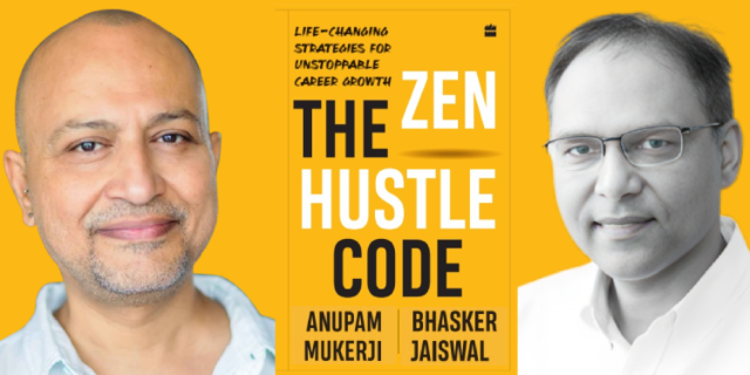
At a time when corporate ambition is increasingly equated with long hours, constant availability, and relentless pressure, The Zen Hustle Code challenges the very foundation of hustle culture. Co-authored by Bhasker Jaiswal, former COO – Media Business at Dentsu India, and Anupam Mukerji, widely known as the anonymous blogger “Fake IPL Player,” the book presents a practical framework for achieving professional success without burnout.
Drawing on over 25 years of global advertising experience, Jaiswal distils real-world lessons on leadership, promotions, workplace dynamics, and decision-making, while advocating a shift from effort-driven to impact-led growth.
In an interaction with MediaNews4U, the authors decode the philosophy behind “Zen Hustle,” challenge prevailing career myths, and outline actionable principles for sustainable success. Here are edited excerpts from the conversation:
Q1. How do you define “Zen Hustle,” and what inspired you to challenge traditional hustle culture through The Zen Hustle Code?
Bhasker Jaiswal: Having spent over 25 years in advertising across multiple countries, I’ve experienced how the industry normalises pressure, long hours, and relentless deadlines. Early in my career, I was conditioned—like many professionals—to believe that success was directly proportional to how hard and how long you worked. This mindset is deeply rooted, especially in Indian households, where effort is often equated with sacrifice.
Over time, however, I saw a recurring pattern of people burning out, yet continuing on the same path because they believed there was no alternative. Globally too, the narrative seemed binary—either overwork yourself to exhaustion or step away entirely. I realised there had to be a middle path: one that focuses on output and effectiveness rather than sheer effort or hours logged. That thinking became the foundation of “Zen Hustle.” The idea behind the book was to document these principles so that professionals—especially younger ones—don’t spend decades discovering this the hard way.
Anupam Mukerji: I had been observing Bhasker’s career for nearly two decades, mostly from a distance, and what stood out was the balance he maintained. He was clearly successful, had reached senior leadership roles, yet didn’t exhibit the constant stress and urgency we typically associate with such positions.
When he returned to India, I saw this even more closely—he had time for family, sports, and personal life, while continuing to excel professionally. That contrast made me curious. As we spoke, it became clear that he had developed a set of operating principles—almost like a personal code—that allowed him to succeed without burnout or politics. We felt that this knowledge shouldn’t remain limited to one individual. It was important to share it in a structured way so that more people could pursue success without compromising their health, relationships, or mental well-being.
Q2. Was there a defining moment when you realised constant overwork isn’t the only path to success?
Bhasker Jaiswal: That realisation actually started quite early, during my college years. Until school, most people follow a similar structured path, but in college you meet individuals from diverse backgrounds with very different approaches. I observed that many were putting equal effort into everything—attending every class, making detailed notes, trying to maximise marks across all subjects.
My approach was different. I focused on identifying my strengths and prioritising areas where I could maximise outcomes. Instead of spreading effort evenly, I concentrated on what mattered most. Interestingly, this resulted in better performance despite not “overworking” in the traditional sense.
This pattern repeated in my professional life as well. I realised that many people focus excessively on activity rather than effectiveness. They follow established processes without questioning them. My learning was that sharpening your craft, thinking from first principles, and prioritising impact over effort leads to far better results than simply putting in long hours.
Q3. Is it truly possible to reach the C-suite without overextending yourself, especially in high-pressure industries like advertising?
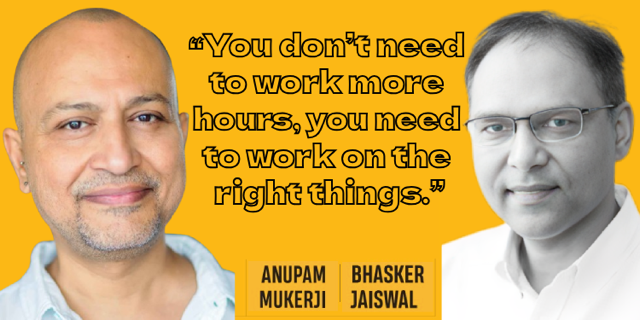
Bhasker Jaiswal: Yes, it is absolutely possible—but it requires redefining what “overextension” means. You may need to stretch yourself intellectually, but not necessarily in terms of hours worked. Success comes from clarity of thought, prioritisation, and the ability to filter out noise, especially in high-pressure environments where distractions are amplified.
Many professionals fall into what I call an “arms race of effort,” where longer hours are equated with higher commitment. But this often leads to diminishing returns. If you can focus on high-impact work and avoid unnecessary distractions, you can progress to leadership roles without burning out. It’s not about doing more—it’s about doing what matters most.
Anupam Mukerji:The Zen Hustle approach doesn’t advocate avoiding hard work—it advocates being selective about where you apply that effort. One of the key principles we discuss is identifying your “superpower”—the area where you can create disproportionate value—and focusing most of your energy there.
For example, instead of repeating the same work across multiple clients, Bhasker created scalable frameworks that could be applied repeatedly. This reduced effort while increasing impact. Over time, such approaches compound and differentiate you as a leader. Leadership is ultimately about solving problems in a way that creates maximum value with minimum redundant effort.
Q4. What separates good leaders from great leaders?
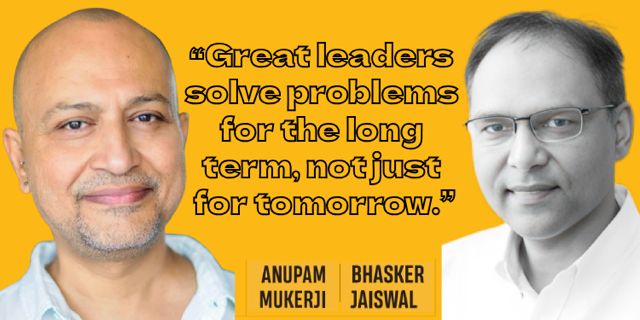
Bhasker Jaiswal: Great leaders move beyond individual contribution and focus on collective outcomes. They operate as coaches, enabling their teams to perform better rather than just driving their own output. Importantly, leadership is not tied to hierarchy—it begins the moment you start managing even one person.
A key distinction lies in how problems are approached. Many managers focus on solving immediate issues, often by increasing effort or pushing teams harder. Great leaders, on the other hand, build systems and structures that solve problems sustainably. They think long-term, ensuring that the same issue doesn’t recur. This shift from reactive to structural thinking is what truly differentiates leadership quality.
Anupam Mukerji: Clarity is one of the most critical attributes. Leaders are constantly surrounded by multiple challenges, but the ability to identify which problems truly matter is what sets great leaders apart.
Equally important is the ability to listen. A strong leader absorbs diverse perspectives before making decisions, ensuring that choices are objective and not driven by emotion or insecurity. Ultimately, leadership is about optimising input versus output—achieving maximum impact with limited resources such as time, talent, and budgets.
Q5. What are the biggest misconceptions young professionals have about career growth today?
Bhasker Jaiswal: One of the biggest misconceptions is that success can only be achieved through burnout or office politics. Many professionals believe these are the only viable routes and end up overinvesting in both, often at the cost of their well-being.
Another issue is misdirected effort. Instead of focusing on building strong core skills, individuals often spend time on peripheral activities. Additionally, there is a tendency to expect organisations to drive career growth, rather than taking ownership of one’s own trajectory. Viewing oneself as an independent value creator rather than just an employee is a critical shift that many miss.
Anupam Mukerji: The belief that one must constantly please the boss is deeply ingrained but flawed. While relationships matter, long-term success is driven by the value you create. If your work is impactful, it naturally earns respect.
Another common trap is over-indexing on visibility—being the first to arrive, the last to leave, or constantly available. While this may offer short-term recognition, it is not sustainable and often leads to burnout. Building competence and self-worth is far more important.
Q6. How should professionals understand and navigate office politics?
Anupam Mukerji: Office politics is essentially human behaviour shaped by incentives. While it exists in every organisation, actively engaging in it is often a low-return strategy.
The key is to be aware of it without becoming a participant. If you consistently deliver high-value work, you naturally operate above politics. As we highlight in the book, excellence in output is the strongest defence against political dynamics.
We often reference MS Dhoni as a real-world example. Despite leading for years, he remained largely untouched by controversies and focused purely on performance. That is the essence of the Zen Hustler approach—stay aware, but stay above.
Q7. What are the red and green flags professionals should look for in workplace culture?
Bhasker Jaiswal: One important perspective is to stop viewing organisations as “families.” Companies are business entities, and professionals must approach them with the same clarity.
Red flags include lack of recognition for output, limited growth opportunities, and environments where effort is valued over impact. On the other hand, green flags are organisations where meritocracy prevails and where individuals can grow based on their capabilities.
Anupam Mukerji: Respect for boundaries is a critical indicator. If personal boundaries are consistently ignored, it signals a deeper cultural issue. Professionals must define and enforce these boundaries early, as it becomes increasingly difficult to reset expectations later.
Q8. How can individuals build influence and leadership presence without burnout-driven approaches?
Anupam Mukerji:Influence comes from the strength of your work. When your output is consistently high-quality and impactful, it naturally commands attention. There is no need for aggressive self-promotion or political manoeuvring.
The Zen Hustler approach is about being so good at what you do that your work speaks for itself. Over time, this builds credibility, trust, and leadership presence organically.
Q9. Is hustle culture failing younger professionals today?
Bhasker Jaiswal:Yes, and the evidence is visible at both individual and organisational levels. Individuals face burnout, anxiety, and declining health, while organisations suffer from disengaged employees delivering average output.
Although younger generations are beginning to question this model, widespread acceptance that the system itself is flawed is still evolving. Recognising that there are alternative, more sustainable ways of working is the first step toward meaningful change.
Q10. What key mindset shift should professionals adopt from The Zen Hustle Code?
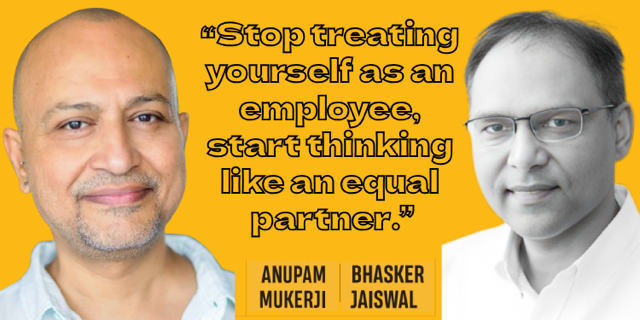
Anupam Mukerji:The most important shift is to stop viewing oneself as subordinate to the organisation. Instead, professionals should see themselves as equal partners in a value exchange.
This shift changes how you approach work, negotiate, and make decisions. When you recognise your own value, it reflects in how others perceive and treat you as well.
Q11. What is the book’s perspective on work-life balance?
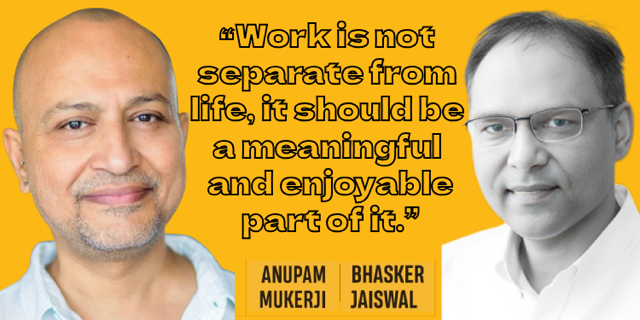
Bhasker Jaiswal:The concept of work-life balance is often misunderstood because it assumes that work and life are separate or even conflicting. In reality, work forms a significant part of our lives and should ideally be fulfilling.
The goal is not to escape work, but to make it engaging and enjoyable. When approached correctly, work can contribute to overall happiness rather than detract from it.
Anupam Mukerji: Work is an integral part of life, not something separate from it. When you bring the right mindset, it can be both productive and enjoyable. In fact, we approached writing The Zen Hustle Code in the same spirit—it was an enjoyable process, filled with curiosity and creativity, which is exactly what we advocate for professionals as well.
Published by HarperCollins India, The Zen Hustle Code is available on Amazon.