By the time the first ball of IPL 2026 was bowled, the match had already been playing for weeks. On YouTube, creators were dissecting auction strategies. On Google Search, fans were asking whether it would be Virat Kohli’s last season. In living rooms across Tamil Nadu and Uttar Pradesh, regional watch-along hosts were warming up their commentary. The stadium was already full — it just wasn’t physical.
Welcome to what Google India is calling the “Infinite Stadium”: a 24/7, multi-screen, AI-powered cricket culture that has fundamentally transformed how the sport is experienced, monetised, and marketed. In a cricket-mad nation, the howzat is no longer just for the umpire. It is a question the entire digital economy is answering in real time.
The Numbers That Changed Everything
The headline statistic from Google’s latest data is striking: 66% of all cricket-consumption time is now spent on non-live, surround content — the analysis, the drama, the memes, the creator commentary — compared to just 34% on live broadcasts. For a sport whose entire commercial architecture was built on the premise of live viewership, that is nothing short of a structural disruption.
With 90% of fans active on a second screen while watching the game, the stadium is, quite literally, in their hands. The action does not stop when the broadcast cuts to an ad break. It migrates — to a search bar, a YouTube channel, a creator’s live reaction feed.
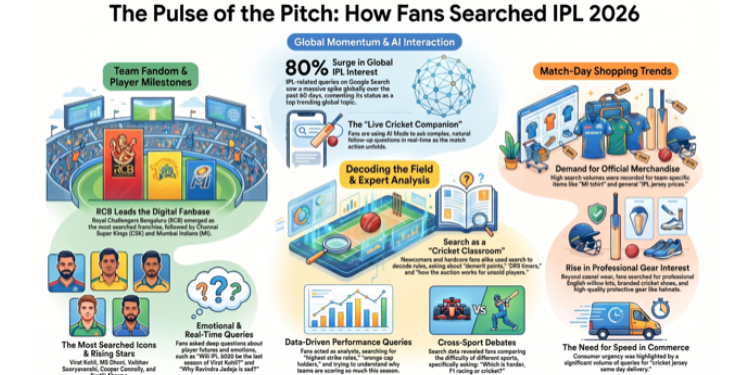
Underpinning this shift is a content explosion on YouTube that defies easy comprehension. Cricket-related views surged from 50 billion to 190 billion in just 18 months — a near four-fold jump that places cricket among the most dominant content categories on the platform globally. Simultaneously, IPL-related queries on Google Search spiked 80% globally over a 60-day window this season, cementing the tournament as a top trending global topic. The driving force behind much of this growth: AI-powered search features that turned a passive lookup into an immersive, interactive experience.
The implication for India’s $130 billion sports economy is profound. The fan journey no longer begins at the toss and ends at the final wicket. It is always on, always searching, and increasingly — always buying.
The Two Fields of the Infinite Stadium
This new game is played across two interconnected platforms, each serving a distinct but complementary function in the fan journey.
The journey typically starts with Google Search — a single curious question sparked mid-match. “What is a maiden century?” “Will IPL 2026 be the last season of Virat Kohli?” “Cricket jersey same day delivery.” That moment of real-time curiosity triggers a digital deep dive: into statistics, player histories, tactical analysis, and team merchandise.
From there, the conversation moves to YouTube, where fans go deep into the topics they love with their favourite creators. The loop is continuous — curiosity born on Search, explored at length on YouTube, then generating fresh questions that send fans back to Search again. This cycle of engagement is what has driven cricket views to that 190-billion landmark, and what keeps the Infinite Stadium’s gates permanently open.
Four Ways Fans Are Searching IPL 2026
IPL has dominated Google’s Year in Search sports trends in India every year since 2020. This season, the scale and sophistication of how fans used Search reached a new level — spanning team loyalty, rule-decoding, analytical deep dives, and match-day commerce. Here is what the data revealed.
1. Team Fandom: The Emotional Core
Millions of supporters turned to Search to follow their favourite franchises in real time. Royal Challengers Bengaluru (RCB) emerged as the most searched team across India this season, followed closely by Chennai Super Kings (CSK) and Mumbai Indians (MI) — a ranking that reflects both on-field performance and the depth of each franchise’s digital community.
Player interest spanned the full spectrum from legend to emerging talent. The top five most searched players this season were Virat Kohli, MS Dhoni, Vaibhav Sooryavanshi, Cooper Connolly, and Kartik Sharma — a pairing of established icons and the next generation that illustrates how Search mirrors the emotional arc of an IPL season itself.
Fans were not merely tracking scoreboards. They were following careers, monitoring fitness, and asking deeply personal questions about their heroes. Queries ranged from the tactical — “Is Rohit Sharma playing IPL 2026?” and “2026 mein IPL Jasprit Bumrah kaun si team mein” — to the sentimental: “How many hundreds does Kohli have in IPL?”, “Will IPL 2026 be the last season of Virat Kohli?”, and, most poignantly, “Why Ravindra Jadeja is sad in yesterday’s IPL.” The last of these is not a statistics query. It is an act of emotional solidarity — a fan reaching toward a player across a digital screen.
2. Decoding the Field: Search as a Cricket Classroom
One of the most significant trends of IPL 2026 was the surge of fans using Google Search as a personal cricket classroom. The tournament’s growing global audience brought with it a wave of curious newcomers — and even seasoned watchers — seeking to understand the game at a deeper level.
Rule-decoding queries spiked sharply: “Semi final qualify karne ke liye kitne point chahiye in IPL?”, “What does 1 demerit point mean in cricket IPL?”, “What is DRS timer in cricket?” Fans also looked behind the curtain of the tournament’s machinery, asking “What is the role of director of cricket in the IPL?” and “How does IPL auction work for unsold players?”
The curiosity extended to cricket’s fundamentals: “How long is a cricket pitch?”, “What is the meaning of a leg break in cricket?”, “What is maiden century in cricket?”, “Why does 11th guy in cricket not bat?”, and — in a query that perfectly captures the blend of reverence and bewilderment that cricket can inspire — “Why bat is checked on ground in IPL.”
This is not the behaviour of a peripheral audience. It is the behaviour of a sport expanding its tent, welcoming new converts, and giving them the tools to belong. For brands targeting new cricket audiences, this cohort represents one of the most valuable and under-addressed segments in Indian sports marketing.
3. Expert Analysis: The Fan as Analyst
At a higher level of engagement, IPL 2026 saw fans using Search as an analytical sounding board — not just to find information, but to interrogate it. These fans treated match data the way a trading desk treats market data: as inputs to be decoded, compared, and challenged.
Performance queries were highly specific: “2026 ke IPL mai ab tak kitne players century bana chuke hai”, “Which player has the highest strike rate in the IPL?”, “Who has the most orange cap in IPL?” Macro-level curiosity about the season’s striking patterns produced questions like “Why are teams scoring so much in the IPL?” — a query that reveals fans attempting to situate individual matches within a broader statistical narrative.
Perhaps most tellingly, IPL 2026 generated a wave of cross-sport debate queries — “Which is faster, F1 racing or cricket?”, “Which is harder, F1 racing or cricket?” — that signal cricket’s expanding cultural footprint. The tournament is no longer just competing for attention within the sports category. It is asserting itself within a broader global conversation about athletic excellence.
4. Match-Day Shopping: Commerce at the Speed of Cricket
The fourth and commercially most consequential search trend of IPL 2026 was the emergence of real-time, emotionally driven shopping behaviour. Fans did not want to order a jersey for next week. They wanted it for tonight.
Search data revealed a sharp spike in same-day delivery queries for cricket jerseys — a behaviour pattern more typically associated with food delivery than apparel, and a signal of just how visceral the connection between fan identity and match-day experience has become. High search volumes were recorded for “IPL jersey price”, “MI tshirt”, “cricket helmet”, and “hats for cricket” — terms that map precisely onto the impulse of a fan watching their team walk out to bat and wanting, immediately, to wear the colours.
Beyond replica merchandise, the data points to a deeper and more durable commercial signal: the rise of professional gear interest. Fans searched for branded cricket shoes, sunglasses, and professional-grade English willow kits — suggesting that IPL’s cultural penetration is converting passive viewers into active participants in the sport itself. The tournament is not merely a media property. It is a participation trigger.
Three Fans, Three Distinct Economies
Cutting across all four search behaviours is a segmentation framework that Google’s research has identified as essential for understanding — and reaching — the Infinite Stadium’s audience. Cricket’s digital fan base is not monolithic. It comprises three distinct subcultures, each with its own emotional logic and commercial profile.
The Flirters — Cricket as Pop Culture. At the widest end of the funnel sit the cultural consumers: fans who may not know the difference between a DRS review and a free hit, but who know exactly when a meme is shareable and when a celebrity moment is culturally significant. They are the primary engine of viral velocity on YouTube Shorts, and they drive breakout spikes in trivia and celebrity fandom searches. For them, cricket is a pop-culture property. Brands chasing reach at scale cannot afford to ignore this audience — and yet they are often the hardest to engage through traditional sports marketing.
The Casual Fans — Cricket as Narrative. More invested but not yet obsessive, these fans have moved beyond highlight fatigue. They follow storylines rather than scorecards. The emotional weight of a query like “Will IPL 2026 be the last season of Virat Kohli?” is their native language. They turn to regional watch-along creators and franchise-aligned YouTube channels as emotional proxies — seeking the feeling of communal viewing even when they are watching alone. They are the core audience for long-form creator content and for the franchise community-building strategies that are reshaping Indian sports business.

The franchises that have built the deepest digital communities are those that have learned to read this emotional register, not just track it. As Piyush Sharma, Creative Head of Punjab Kings, puts it: “Answering a fan’s question is easy… But reading their emotions? That’s the real skill. Today, tools make it easier… The goal is to break the wall between the team and the fans. The more you personalize content and respond emotionally, the stronger the connection becomes. Fans don’t want distance — they want to feel seen.”
The Hardcore Fans — Cricket as Data. At the apex sits the tactical auditor: the fan who treats every match as a dataset to be interrogated. They use Search to decode strategy, benchmark performance, and understand the sport’s underlying structures. On YouTube, they seek out expert analysis, advanced breakdowns, and skill tutorials. They are also the consumers most likely to purchase professional-grade equipment — English willow kits, branded shoes, high-quality helmets — rather than replica jerseys. Their attention is harder to earn and more valuable to keep.
AI Rewrites the Rules of Fan Engagement
Cutting across all three subcultures is a development that carries significant long-term implications: the rise of AI Mode as a real-time cricket companion.
Fans are no longer searching for information. They are conducting conversations with Search itself — asking complex, layered, contextual follow-up questions as match situations evolve. The query is no longer the endpoint; it is the beginning of a dialogue. Google’s collaboration with BCCI this season took this further, integrating AI-powered analysis into live broadcasts themselves, making the Infinite Stadium a feature of the official viewing experience, not just a parallel one.
This represents a fundamental re-architecture of the fan-sport relationship. Broadcast was historically a one-way transmission. The Infinite Stadium, powered by AI Search and creator content, is a conversation — one that continues long after the stumps are drawn.
The Creator Economy as Distribution Layer
One of the most consequential structural shifts of IPL 2026 is the ascendancy of the creator as the primary intermediary between franchises, brands, and fans. Regional creators — producing content in Tamil, Telugu, Bengali, Marathi, and beyond — have built communities of extraordinary loyalty and specificity. Watch-along formats have emerged as a genuine substitute for communal viewing, with creators functioning as de facto commentators, emotional companions, and community anchors.
Franchises have responded. RCB’s dominance of team search volumes — ahead of CSK and MI — reflects not just on-field results but a year-round digital content strategy that sustains fan engagement across the 300-odd days when no cricket is being played. The insight driving this shift: the emotional equity built in the off-season is what converts a casual viewer into the fan who searches “cricket jersey same day delivery” at 7 PM on match night.
For advertisers, the playbook has crystallised around three imperatives: capture curiosity on Search by being present when fans ask questions; build community on YouTube by partnering with the creators who have become the trusted voices of the game; and go multiformat — combining Shorts velocity, CTV scale, and creator-led integrations to reach relevant audiences at high frequency across every screen.
What This Means for the $130 Billion Equation
India’s sports economy is at an inflection point. The infrastructure of value — broadcast rights, stadium attendance, merchandise licensing — was calibrated for a world where live TV was the primary touchpoint. That world still exists, but it now accounts for barely a third of fan consumption time.
The remaining two-thirds — the search queries, the YouTube deep-dives, the creator watch-alongs, the AI-assisted match analysis, the mid-match jersey orders — represent both the frontier of fan engagement and, for those who navigate it well, the next major growth chapter of Indian sports business.
In the Infinite Stadium, the game never really ends. The final whistle is not a conclusion — it is a prompt. For the next search query. The next emotional milestone query. The next same-day delivery.
Cricket’s second innings has begun. And unlike the first, it runs 24 hours a day.
Sources: Google Trends data (queries tracked across IPL 2026 tournament duration); Google India blog series — “Welcome to the Infinite Stadium” by Shubha Pai; “4 Ways Fans Are Searching IPL 2026”; “The Infinite Inning: How YouTube Expands the World of Indian Sports”; “From Match Day to Every Day: The Business of Building Indian Superfans.”