July 16, 2026, Gurugram: As AI becomes a more common part of the creative process in advertising, questions around its real-world effectiveness continue to surface. New insights from global advertising technology platform VDO.AI indicate that AI-generated ads performed on par with and in some cases marginally outperformed human-created creatives
Based on an analysis of around 200 campaigns using VDO.AI’s campaign data, the company compared the performance of AI-generated and non-AI creatives across CTV, Online Video (OLV) and Rich-Media Display. On CTV, AI-generated ads recorded a 92% video completion rate (VCR), slightly higher than the 90% seen for non-AI creatives. A similar trend appeared in Online Video, where AI-led ads achieved a 71% VCR compared to 70% for non-AI ads. On Rich-Media Display, both AI and non-AI creatives delivered nearly identical click-through rates (CTR), averaging 0.30%.
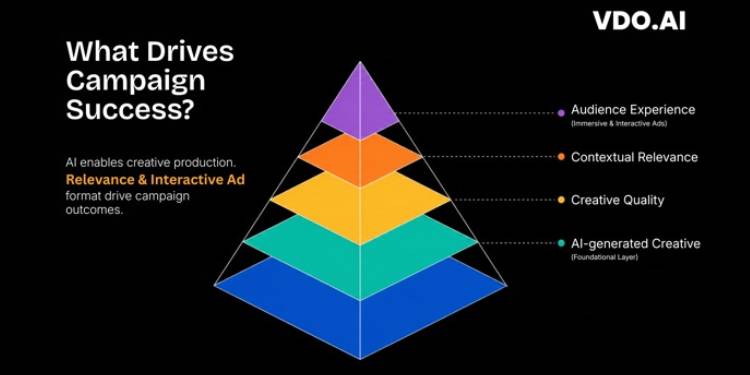
The relatively small performance gap between AI-generated and traditionally developed creatives suggests that AI alone is no longer the defining factor behind campaign success. Instead, the findings signal a broader evolution in digital advertising. As AI becomes increasingly commoditised, competitive differentiation is increasingly driven by immersive ad formats that capture attention, contextual relevance and user experiences that keep viewers engaged, rather than by AI alone. Brands that combine relevant messaging with immersive, interactive ad formats are better positioned to capture attention and drive meaningful engagement.
Arjit Sachdeva, Co-founder of VDO.AI, said, “AI is becoming an integral part of how ads are made, but it doesn’t change how an ad creative performs. This study, developed with inputs from Great Lakes Institute of Management, gave us an opportunity to look beyond assumptions and validate how AI-generated advertising performs in real-world campaign environments. The data proves that people don’t engage with an ad because of how it was created; they engage when it feels relevant, well-timed and immersive. For brands, the real value lies in combining technology with human creativity and strong formats to build ad experiences viewers actually want to spend time with, turning attention into meaningful brand interactions.”
This shift from creative origin to strategic framework is drawing significant attention from marketing educators who are mapping the next generation of industry talent.
Dr. Amit Kumar, Associate Professor and Area Chair, Marketing, Great Lakes Institute of Management, Gurugram, said, “The marketers who win in the next decade won’t be those who resist AI; they’ll be those who learn to direct it with sharper strategic intent. Creative judgment is moving up the value chain, not out of it. Humans will augment the brand truth by using AI to express it in an engaging way. For consumers, the payoff is fewer irrelevant interruptions and more messages that actually meet them in the moment, thus a better customer experience. While strategy remains human, the execution becomes hybrid.”
The findings were drawn from campaigns spanning sectors such as automotive, consumer durables, FinTech, CPG, and lifestyle, where similar engagement patterns were observed across formats. This cross-sector consistency within VDO.AI’s campaign data indicates that AI-assisted creatives can deliver stable performance across CTV, OLV and Rich-Media Display environments.
Developed with inputs from Great Lakes Institute of Management, Gurugram, the report also brings in an academic perspective on how AI is reshaping creative processes and the skills required for the next generation of marketers.
While creative quality and placement remain critical, VDO.AI data shows that AI-generated ads are meeting the same performance benchmarks as human-made creatives. As brands continue to test and refine AI-led approaches to advertising, measurable performance will remain the clearest indicator of value. These insights contribute to a more data-backed understanding of how AI is shaping advertising execution.